old salut!

Colin Randall wrote here on France, things Anglo-French and more......but has moved

April 09, 2007

Impolitesse revisited

A good debate is just taking shape over at my Guardian Comment is Free slot, where I have returned to a favoured theme of rudeness and the French. Have your say, there or here.


Posted by Picasa
Marseille: easy to get lost, harder to be told to Get Lost - if you're polite


But those who have stuck with me from the Other Place, where I now languish in the sidings for archived foreign correspondents (along with, it has to be said, three valued former colleagues), will remember the impassioned discussion my thoughts on the subject aroused there.

They will also know my view that the French, by and large, get an unjustifiably bad press, accused without proper cause of being ruder than others. But then, not all the French agree with me in any case.

My occasional sparring partner Agnès Poirier thinks the French are guilty as charged. but adds that while she and her fellow Français and Françaises are rude, us Brits are hypocrites.

So when I make my case for not being beastly to the French, I am undermined by certain French people taking pride in their rudeness.

Pretty much the flip side of the debate, the subject that that got me going last time around, is the tyranny of the French insistence on a proper bonjour monsieur/madame at the start of any casual exchange.

Is it time for another discussion on that? These days, I rarely forget the need for such introductions, and I bonjoured away merrily, to good effect, a few times when I was lost in Marseille yesterday.

Mme Salut!, French but conditioned by long years spent in England, gets it wrong as often as she doesn't.

If you are far too polite to consider talking about rudeness, there is always the lure of yet another competition, over at (tonight) a somewhat jubilant Salut! Sunderland.

The core subject will be of no interest to many of you, of course, but I'd bet several of you would get the right answer to my question even without recourse to Google.

Some may even like my choice of prize - a copy of an unusual graphic novel, Alice in Sunderland, by Bryan Talbot, about which you can also read a little on that blog, and more here.

And just a few of you will take to the idea of a guest column, even though it has to be about football - note, not specifically Sunderland.

But then again.........

Labels: , , , , ,

February 23, 2007

Over the top? C'est la totale

News reports in France sometimes recount allegations, usually but not always from outside, that the French are "champions" at this (taking time off, consumption of pills, being prone to complain) or mauvaises élèves at that (learning languages, courtesy on the road and so on).

You don't need to be excessively francophile to doubt the accuracy of the claims in the first place.

But can I raise another possible contender? Are people of other countries as given to hyperbole, in everyday conversation, as the French?

When I first arrived in Paris as a new resident back in July 2004, I described my wife's way of combining comprehensive knowledge of English swearwords with a total failure to moderate their use according to strength of curse each situation warranted.

This is not just to do with the occasional domestic dispute that would arise in any household a chic, vivacious and tidy-minded Frenchwoman shares with a dishevelled, football-supporting folkie.

It is simply the case that whenever she swears in English, she starts pretty high up the range.

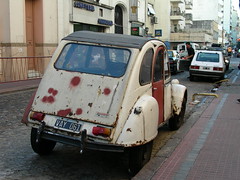
Her sister is one of the most mild-mannered people I know, but was a nightmare to be with when she first started driving, berating just about every other road user with a non-stop flow of shouts and insults from the inside of her Citroën 2CV.

I suppose encounters on the road don't count so much, and I am certainly not sure that French road rage is worse than the British version.

But I have witnessed countless examples of the phenomenon, from the fonctionnaire's utter exasperation at the omission of some piddling detail from a form to the platform attendant's unrestrained abuse aimed at some late-arriving passenger.

A slight nip in the air and it's inevitably "freezing". A minor lapse in manners at the table and papa launches into a tirade, with or without accompanying claques, as if a line of cocaine had tumbled from his child's pocket.

On today's lunchtime news, a little girl on a school ski-ing holiday was interviewed as she lay in bed while her friends enjoyed the snow.

She seemed a long way from death's door, but complained of stomach ache, headache and nausea before adding gravely: "C'est la totale."

Her phrase enriched my knowledge of French - a function, I suppose, of not having children living at home to keep me in touch with their everyday use of the language.

But was her reaction to minor ailments just another isolated instance, no more characteristic of the French than the stiff upper lip is of the English? Or does experience lead others to believe the French are les champions of exaggeration?

Labels: , , , ,

February 05, 2007

When Irish eyes smiled for Ségolène


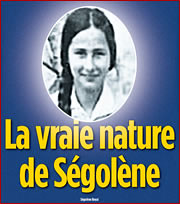
Picture: politiquecafe.
She struggles to impress in her campaign to become France's first woman president. But Ségolène Royal will at least have seen one recent article that was not calculated to leave her in a steaming rage or cringing with embarrassment.

Rare among the thousands of words written and uttered about Ségo in the past fortnight or more, these were unequivocally positive - telling of her pleasant nature, intelligence and humour.

Paris Match told the story of the young Ségolène as au pair girl, back in 1971 when she was a beautiful, vivacious teenager needing a bit of English practice.


Ségo was not parked in a leafy suburban town in Surrey, or at the London town house of the sort of people who drive Chelsea tractors and have children called Gideon and Arabella. She was sent to Dublin.


What she made of any Guinness or rebel songs she encountered is not known, so far as I am aware. But she did leave a deep and favourable impact on the Irish family whose lives she briefly shared.

Ségolène, or Marie-Ségolène as she was still known as a girl of not quite 18, followed in the footsteps of another French au pair, Armelle, who had evidently been made a sterner stuff.

The change of home help produced a change of atmosphere that was enough for the freckled Roche children - Graziella, John and Peter - to think Mary Poppins had replaced Mademoiselle Cruella.

That may be well unfair on Armelle, though I do recall the surliness of one or two French girls who stayed with us when my daughters were small.

Marie-Ségolène, in any event, was a breath of fresh air for the Roche kids and their large gang of friends, baking everyone cakes, drawing with Graziella or taking her to pony riding lessons and chasing butterflies.

Young Peter remembers her dark blue Bermuda shorts. He was only five but perhaps already had an eye for the feminine charms that have, for no good reason if we are honest, done Ségo little harm in her rise to prominence.

There was also a swattish side to the au pair. The observant Peter retains a vision of Ségo writing copiously in an exercise book, one page after another, as the children watched television.

A meal-time photograph of au pair and young charges accompanies the Paris match report. "She may have been brought up severely," the children's mother, Renate, tells the magazine in a reference to the austere, disciplined regime of Colonel Jacques Royal's household. "But just look at the picture of peace around the table - that sums up her sojourn with us."

I started by giving Paris Match the credit. But let me end by being fair to the man who really brought this interesting little episode of Ségo's life to wider attention.

John Lichfield, the excellent and convivial Paris correspondent of The Independent, heard about the Irish connection from a Dublin lawyer, Sheena Beale.

Sheena met and befriended Ségolène when both were on holiday in Normandy as 16-year-olds. She was out of the country when her French pal arrived as an au pair but put her in touch with friends and relatives.

John then discovered that the Roche children's late father had been best man at the wedding of his own parents-in-law, themselves Dubliners.

Sheena described her Marie-Ségolène as a "strikingly beautiful girl with long, dark hair - I thought she looked like Sophia Loren". The French girl was "great fun to be with but very focused, very determined...I never imagined that she would go into politics but it doesn't surprise me that she has gone so far."

Unlike Paris Match, John found that Renate Roche - now remarried and called Webster - had no recollection of the future presidential candidate among several French au pairs.

Whatever the magazine's envoyé special did to jog her memory for his report entitled Une Baby-sitter nommèe Marie-Ségolène, it's a reasonable bet that Renate will be taking a more personal interest in the progress of the battle for the Elysée.

Labels: , , , , , , , , ,

January 24, 2007

Taking leave of critical senses

Lovers of French cinema come clean, and to my rescue.


Picture: Daryl Van Horne.


Who hasn't quite enjoyed a film in the language of Molière while thinking that if this were in English, it would be dismissed as pornography or trash, or both?

Gérard Depardieu, not to everyone's taste though I find him a likeable mixture of vulgarity and rough-diamond charm, has been in at least a couple of movies fitting one or other description. So has Béatrice Dalle.

The thought occurred as I was smarting from a friend's reaction of utter horror at my admission that I had quite enjoyed The Holiday, the lightweight story of two women - played by Kate Winslet and Cameron Diaz - who swap homes on either side of the Atlantic for a fortnight.

Not even a defensive aside - "I know it's fluffy but watching it in French I really liked it (even if I haven't much time for Diaz or Jude Law" - did me any good. As far as my friend was concerned, I might as well have told her I had decided that line dancing was cool.

Back came the reply: "I can't believe you liked it. I thought it was terrible....."

Terrible, and just to rub it in, "apart, of course, from Jude Law who looked absolutely divine".

I have not read any reviews in what the French like to call the Anglo-Saxon press, and almost certainly won't now, so have no idea if anyone, anywhere, watching in English, came away smiling.

Perhaps someone can come up with an even more distressing example of a film that grew in stature, or seemed to, just because of the language.

There is no similar excuse for having also enjoyed Mel Gibson's Apocalypto, since everyone sees it with subtitles from the Mayan dialect.

But at least here I am in authoritative company. The Guardian's Peter Bradshaw, who must know what he's talking about since he is my elder daughter's favourite critic and she works in film, overcame real personal resistance to give it a four-star review.

"If people have got it in for Mel Gibson," he wrote, "he has only himself to blame. His behaviour has been repulsive. Everyone is prejudiced against his films. I am prejudiced against his films. So the sentence following this is going to take me quite some time to write, because between every keystroke, there will be a three-minute pause while I clench my fists up to my temples and emit a long growl of resentment and rage.
"Mel Gibson's Apocalypto is pathologically brilliant. It is bizarre, stomach-turningly violent and frequently inspired."

The Graun's recommendations, sadly, appear to carry little weight in these parts.

The version we saw, with French subtitles, proved no Sunday afternoon draw at Le Forum, a cinema tucked away in a small shopping centre just along the coast at La Londes-les-Maures.

The man who took our money - only five euros each - also acted as usher and projectionist. He'd have served the ice creams and popcorns, too, had there been any.

As we entered the surprisingly large salle, he detected our surprise at the row after row of empty seats. "Oui," he said with resignation, "vous êtes quatre."

A little pessimistically, he'd reckoned without a late rush. By the time the film started (only a few moments later since Le Forum doesn't mess about with trailers and ads), we had grown to five.

Labels: , , , , , , , , , , , , , ,

January 10, 2007

Elysée election: early result

And the new president of France is Ségolène Royal.


Photograph by: PS Clichy sous Bois.


Don't just listen to me. Ségo's election in May, it seems, is the logical extension of claims by Jean-Marie Le Pen, leader of the far-Right Front National, that he will again make it through to the final round of the race - to face her in the deciding poll.

You would have to take a very dim view of the French to believe that given such a choice, more than a small minority of them would vote for Le Pen.

He naturally takes a different view. And there is some evidence that the opinion polls, which currently give his party only 15-17 per cent of popular support, consistently under-estimate his electoral pull.

But can Le Pen really hope to split the centre-Right vote to such an extent that Nicolas Sarkozy is eliminated in the first round as the socialist candidate Lionel Jospin was in 2002?

As a foreign observer of French politics who identified the presidential potential of Mme Royal some time before most, I am naturally pleased to see my instincts being vindicated.

She has a lead in the national polls, at least on first round voting intentions, and so far seems capable of making light of perceived weaknesses and gaffes.

With her radical - and, says the centre-Right, unworkable - ideas for helping the SDFs (France's great army of homeless people who have been turned into an early election issue), she has even begun to sound a little more Left wing.

This will satisfy some of the doubters in her own Parti Socialiste, who worried about her penchant for New Labour tactics with a French accent, appealing to middle France voters just as Tony Blair once offered olive branches to middle England.

And she has also managed to sound a little more Chiracien, with her echoes during her visit to China of his mantra that the world needs counterbalances to American superpower dominance. This, in turn, will please parts of la France profonde that still approve of the kind of France Jacques Chirac represents, if not of the man himself.

I loved that quote spotted by one of my readers, Richard of Orléans, to the effect that it was a big mistake to think of her as nice but unintelligent when she was in reality highly intelligent but not very nice.

But it won't harm her; in the end, I suspect a lot of French people sympathise with her riposte that what critics see as faults in her - her steeliness and ambition -would be considered virtues in a man.

If I am determined to rule out Le Pen's chances of bringing everlasting shame to France by reaching the Elysée, I am not wavering in my belief that M Sarkozy remains a massive obstacle to Mme Royal (and, of course, to M Le Pen's unappealing prediction).

Sarko will be formally installed as the UMP candidate this weekend and we will then see his campaign enter a much more urgent phase.

He is more than a match for Mme Royal in political debate, though his own female supporters have already urged him to avoid being seen as macho and sexist in his clashes with her.

When he talks about immigration and crime, and backs his words with firm action, he clearly impresses large numbers of voters and speaks their language.

Across the south of France from Marseilles to the Italian border, a new poll suggests, he is way ahead of both the socialists and Le Pen.

Questions have been asked this week about his dual role, candidate and minister (not forgetting that as well as being interior minister, the equivalent of the British Home Secretary, he is No 2 to Dominique de Villepin in government).

But he can be expected to stand down soon as France No 1 Cop - that's how the press likes to describe the interior minister - to concentrate on getting into the Elysée.

De Villepin has said he will not give his formal support to Sarko, but this is no surprise. Usually, of course, they don't even seem to belong to the same party, let alone work together in the top two Cabinet roles.

Since de Villepin notoriously is not even an elected politican, the absence of an endorsement from him will inflict little or no damage on the Sarko campaign. Nor will there be much fall-out from President Chirac's constant put-downs of his interior minister's more robust approach to solving France's problems.

But what of M Chirac's own immediate plans? Until quite recently, he was widely seen as an elderly man going through the motions of seeing out his final months of presidency, moreover a presidency judged by most to have been an abject failure.

In his New Year messages, however, he has taken to making what sound very much like declarations of intent for a further five-year mandate. His stance on the war in Iraq has increasingly been lauded as a rare success of his time as head of state.

Surely the very idea of him standing for a third term of office remains preposterous.

Maybe. But it has been treated by some commentators and political reporters in recent weeks as if well within the bounds of possibility.

The UMP, broadly, doesn't want him, nor does the public. But can we yet be sure? Le Figaro suggested the other day that he was talking up his programme of action for France's future as if he saw himself as the man to put it into effect.

M Chirac's wife, Bernadette, enjoyed causing a bit of mischief a month or two back by suggesting that her husband might yet put himself forward again.

And she did little to discourage the speculation when she stonewalled such questions while appearing on peak time television a couple of nights ago.

If, against all logic, he does stand, what banner will he choose? Since Sarko will be the official UMP choice, we could be looking at a One Nation One People contender offering, essentially, more of the same at just the time when France arguably needs something quite different.

Mme Chi-Chi can't or won't say. After insisting, implausibly, that such matters are simply not discussed between husband and wife, she added that Jacques would not even inform her of his decision until the eve of his eventual announcement.

What if he said he was going for it? Could such a step be sufficiently divisive of conservative voters to make the first part of M Le Pen's analysis come true?

Labels: , , , , , , , , , , , , ,

December 08, 2006

Pardon the French

Sometimes I back the right horses.

This year's Carpette Anglaise awards, more barbed bouquets than trophies and given to those considered to have done the gravest disservice to the French language, have gone where Salut! suggested they would.

For the main English Doormat prize, step forward the body of august French dignitaries that is France's Conseil Constitutionnel, or constitutional council.


The council's crime, in the eyes of the French language purists who make up l'Académie de la Carpette Anglaise, involved "numerous" breaches of Article 2 of the French constitution, which declares that the language of the Republic of France is indeed French.


Faut-il conseiller le Conseil?

Specifically this year, the council dismayed the judges by endorsing a London protocol agreement on patents that allows text in English or German to have legal effect in France.

This was one of the two co-defendants I tipped for victory. It would have more fun had the judges opted for my other choice - Philippe Baudillon, France 2's director general, for screening programmes called Top of the Pops and Dancing Show - but the Academy is made of more sombre stuff.

For the international prize, I am pleased to reveal the winner as my clear favourite Ernest-Antoine Seillière, president of the European Business Confederation (UNICE,) for delivering a Brussels speech in English.

This minor affront to the la Francophonie became a cause célèbre only because of Jacques Chirac's contrived tantrum, leading a silly little walk-out as M Seillière began his address.

Marc Favre d'Echallens, secretary of the Carpette Anglaise body representing four associations that defend French, brought me news of the results along with a reminder of the criteria.

In particular, to win the main prize, some member of the "French elite" must distinguish himself (or herself or itself) with great efforts to promote the domination of Anglo-American to the detriment of French.

I have yet to see a reaction from the recipients of these 2006 civic dishonours.

But nor have I seen much evidence that the French in general are about to drop anglicised words and expressions from everyday conversation or writings.

Perhaps ça ne roule pas cool after all.

Labels: , , , , , , , , , ,