old salut!

Colin Randall wrote here on France, things Anglo-French and more......but has moved

March 22, 2007

Minding our language*

It is time I lived up to the claim in my description, in the words that appear above, of what Salut! is about when it is not about France: "much more besides".

All that scolding in the comments field after my posting on the pools win that wasn't - the use of irony went down poorly with Smiley - reminded me of one of life's lesser known certainties.


If you somehow acquire a reputation as a pedant, as I did when working on the newsdesk of a newspaper that cared quite a lot about style and grammar, you should not be surprised to find that people cannot wait for you to falter.

Tim - to be a tragedy, or not to be a tragedy - and Smiley, along the lines of get a grip man, your dad did win the pools, left me with that biter bit sort of feeling I have not experienced since I sparred with belligerent contributors to my Telegraph blog.

But it is all perfectly fair sport, so far as I am concerned. How could it be otherwise when I post a reply promising to write about pendantry, as Bill spotted so sharply in his much-missed riposte (something to with suspense, I think, though this posting offers him the chance of another outing for his "best joke in a long time")?

Many of the people I have encountered over the years would be surprised to hear that anyone ever saw fit to make me a custodian of the correct use of English. The queue would be headed by all those teachers I failed to impress at school, and close behind would be the ghost of the Bishop Auckland alderman who interrupted a breathless telephone interview to exclaim: "Stop gabbling, young man."

My newsdesk job naturally went far beyond the discouragement of tabloid constructions, which have become commonplace throughout the media, and the lazy repetition of infantile reporting devices that are the stock in trade of most news agencies.

But that part of my role was justified by the strict view, taken by the man who then edited the paper, of style breaches, sloppy grammar and incorrect use of words.

Colleagues liked to mock my attempts to enforce the editor's will, not least because there were also issues of my own choosing to be raised from time to time.

If the policy had any success, it was in making reporters and specialists a little more careful about the stories they submitted. Any newspaper tends to look more grown-up when it does not simply shovel news agency copy - or copy that might have been dashed off by a news agency - into its pages, but looks to its own staff for work of a higher standard.

Only once was I given cause to regret the enthusiasm with which I approached this part of my work.

That was when the Queen's English Society invited me to be the guest speaker at its annual general meeting. Even without the ribbing of colleagues who threatened to organise a coach party and barrack every word, I would have seen that this was hardly a situation in which I could not lose.

The newspaper stickler was entering the domain of the hardcore pedant.

There was, of course, the coward's escape route. I was sorely tempted. In the end, I decided to accept the invitation and set myself the task of composing a speech with sufficient flattery of the society and its work, and modesty about my own efforts, to see me through without too much damage.

The first part was easy; I needed only to summarise the reason for the invitation, an exchange of letters in which I had accepted the QES's criticism of a particular news report.

The society's official with whom I corresponded was so accustomed to being ignored, or at best to receiving pompous replies to all such approaches, that she warmed instantly to this man who actually wrote back in agreement.

But the second component of my self-defence mechanism was trickier.

I realised that the society's members would study every word of my speech, and every aspect of its delivery, and spare no mercy in the event of the slightest slip.

So I used the following paragraph in my attempt to pre-empt any such challenge:

When I sat down to write this speech, I privately gave it the working title, 'Confessions of a Pedant'. I am not sure that I have necessarily lived up to that self-billing. I am, in my own way, a pedant, but I feel I have little to confess. I hope that my colleagues regard my interventions as helpful, not those of a bully. I do not present myself to them, and I certainly do not present myself to you, as one whose own written or spoken English is beyond reproach. Readers, fellow journalists and others have taken me to task more than once. I take full responsibility for each flattened vowel, any grammatical lapse and all flawed logic.


It didn't leave them much scope for launching a ferocious assault when it came to questions, and it is my response to critics now.

* The title eventually given (by me) to the speech to the Queen's English Society AGM at the New Cavendish Club, west London on September 27, 2003.

Labels: , , , , , ,

February 23, 2007

Over the top? C'est la totale

News reports in France sometimes recount allegations, usually but not always from outside, that the French are "champions" at this (taking time off, consumption of pills, being prone to complain) or mauvaises élèves at that (learning languages, courtesy on the road and so on).

You don't need to be excessively francophile to doubt the accuracy of the claims in the first place.

But can I raise another possible contender? Are people of other countries as given to hyperbole, in everyday conversation, as the French?

When I first arrived in Paris as a new resident back in July 2004, I described my wife's way of combining comprehensive knowledge of English swearwords with a total failure to moderate their use according to strength of curse each situation warranted.

This is not just to do with the occasional domestic dispute that would arise in any household a chic, vivacious and tidy-minded Frenchwoman shares with a dishevelled, football-supporting folkie.

It is simply the case that whenever she swears in English, she starts pretty high up the range.

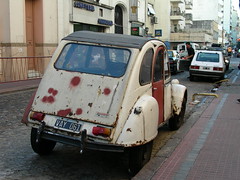
Her sister is one of the most mild-mannered people I know, but was a nightmare to be with when she first started driving, berating just about every other road user with a non-stop flow of shouts and insults from the inside of her Citroën 2CV.

I suppose encounters on the road don't count so much, and I am certainly not sure that French road rage is worse than the British version.

But I have witnessed countless examples of the phenomenon, from the fonctionnaire's utter exasperation at the omission of some piddling detail from a form to the platform attendant's unrestrained abuse aimed at some late-arriving passenger.

A slight nip in the air and it's inevitably "freezing". A minor lapse in manners at the table and papa launches into a tirade, with or without accompanying claques, as if a line of cocaine had tumbled from his child's pocket.

On today's lunchtime news, a little girl on a school ski-ing holiday was interviewed as she lay in bed while her friends enjoyed the snow.

She seemed a long way from death's door, but complained of stomach ache, headache and nausea before adding gravely: "C'est la totale."

Her phrase enriched my knowledge of French - a function, I suppose, of not having children living at home to keep me in touch with their everyday use of the language.

But was her reaction to minor ailments just another isolated instance, no more characteristic of the French than the stiff upper lip is of the English? Or does experience lead others to believe the French are les champions of exaggeration?

Labels: , , , ,

February 05, 2007

When Irish eyes smiled for Ségolène


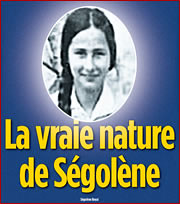
Picture: politiquecafe.
She struggles to impress in her campaign to become France's first woman president. But Ségolène Royal will at least have seen one recent article that was not calculated to leave her in a steaming rage or cringing with embarrassment.

Rare among the thousands of words written and uttered about Ségo in the past fortnight or more, these were unequivocally positive - telling of her pleasant nature, intelligence and humour.

Paris Match told the story of the young Ségolène as au pair girl, back in 1971 when she was a beautiful, vivacious teenager needing a bit of English practice.


Ségo was not parked in a leafy suburban town in Surrey, or at the London town house of the sort of people who drive Chelsea tractors and have children called Gideon and Arabella. She was sent to Dublin.


What she made of any Guinness or rebel songs she encountered is not known, so far as I am aware. But she did leave a deep and favourable impact on the Irish family whose lives she briefly shared.

Ségolène, or Marie-Ségolène as she was still known as a girl of not quite 18, followed in the footsteps of another French au pair, Armelle, who had evidently been made a sterner stuff.

The change of home help produced a change of atmosphere that was enough for the freckled Roche children - Graziella, John and Peter - to think Mary Poppins had replaced Mademoiselle Cruella.

That may be well unfair on Armelle, though I do recall the surliness of one or two French girls who stayed with us when my daughters were small.

Marie-Ségolène, in any event, was a breath of fresh air for the Roche kids and their large gang of friends, baking everyone cakes, drawing with Graziella or taking her to pony riding lessons and chasing butterflies.

Young Peter remembers her dark blue Bermuda shorts. He was only five but perhaps already had an eye for the feminine charms that have, for no good reason if we are honest, done Ségo little harm in her rise to prominence.

There was also a swattish side to the au pair. The observant Peter retains a vision of Ségo writing copiously in an exercise book, one page after another, as the children watched television.

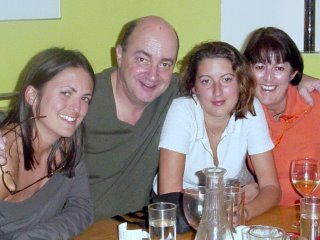
A meal-time photograph of au pair and young charges accompanies the Paris match report. "She may have been brought up severely," the children's mother, Renate, tells the magazine in a reference to the austere, disciplined regime of Colonel Jacques Royal's household. "But just look at the picture of peace around the table - that sums up her sojourn with us."

I started by giving Paris Match the credit. But let me end by being fair to the man who really brought this interesting little episode of Ségo's life to wider attention.

John Lichfield, the excellent and convivial Paris correspondent of The Independent, heard about the Irish connection from a Dublin lawyer, Sheena Beale.

Sheena met and befriended Ségolène when both were on holiday in Normandy as 16-year-olds. She was out of the country when her French pal arrived as an au pair but put her in touch with friends and relatives.

John then discovered that the Roche children's late father had been best man at the wedding of his own parents-in-law, themselves Dubliners.

Sheena described her Marie-Ségolène as a "strikingly beautiful girl with long, dark hair - I thought she looked like Sophia Loren". The French girl was "great fun to be with but very focused, very determined...I never imagined that she would go into politics but it doesn't surprise me that she has gone so far."

Unlike Paris Match, John found that Renate Roche - now remarried and called Webster - had no recollection of the future presidential candidate among several French au pairs.

Whatever the magazine's envoyé special did to jog her memory for his report entitled Une Baby-sitter nommèe Marie-Ségolène, it's a reasonable bet that Renate will be taking a more personal interest in the progress of the battle for the Elysée.

Labels: , , , , , , , , ,

December 08, 2006

Pardon the French

Sometimes I back the right horses.

This year's Carpette Anglaise awards, more barbed bouquets than trophies and given to those considered to have done the gravest disservice to the French language, have gone where Salut! suggested they would.

For the main English Doormat prize, step forward the body of august French dignitaries that is France's Conseil Constitutionnel, or constitutional council.


The council's crime, in the eyes of the French language purists who make up l'Académie de la Carpette Anglaise, involved "numerous" breaches of Article 2 of the French constitution, which declares that the language of the Republic of France is indeed French.


Faut-il conseiller le Conseil?

Specifically this year, the council dismayed the judges by endorsing a London protocol agreement on patents that allows text in English or German to have legal effect in France.

This was one of the two co-defendants I tipped for victory. It would have more fun had the judges opted for my other choice - Philippe Baudillon, France 2's director general, for screening programmes called Top of the Pops and Dancing Show - but the Academy is made of more sombre stuff.

For the international prize, I am pleased to reveal the winner as my clear favourite Ernest-Antoine Seillière, president of the European Business Confederation (UNICE,) for delivering a Brussels speech in English.

This minor affront to the la Francophonie became a cause célèbre only because of Jacques Chirac's contrived tantrum, leading a silly little walk-out as M Seillière began his address.

Marc Favre d'Echallens, secretary of the Carpette Anglaise body representing four associations that defend French, brought me news of the results along with a reminder of the criteria.

In particular, to win the main prize, some member of the "French elite" must distinguish himself (or herself or itself) with great efforts to promote the domination of Anglo-American to the detriment of French.

I have yet to see a reaction from the recipients of these 2006 civic dishonours.

But nor have I seen much evidence that the French in general are about to drop anglicised words and expressions from everyday conversation or writings.

Perhaps ça ne roule pas cool after all.

Labels: , , , , , , , , , ,