old salut!

Colin Randall wrote here on France, things Anglo-French and more......but has moved

February 05, 2007

When Irish eyes smiled for Ségolène


Picture: politiquecafe.
She struggles to impress in her campaign to become France's first woman president. But Ségolène Royal will at least have seen one recent article that was not calculated to leave her in a steaming rage or cringing with embarrassment.
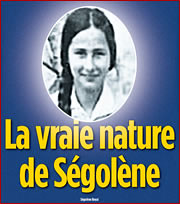
Rare among the thousands of words written and uttered about Ségo in the past fortnight or more, these were unequivocally positive - telling of her pleasant nature, intelligence and humour.

Paris Match told the story of the young Ségolène as au pair girl, back in 1971 when she was a beautiful, vivacious teenager needing a bit of English practice.


Ségo was not parked in a leafy suburban town in Surrey, or at the London town house of the sort of people who drive Chelsea tractors and have children called Gideon and Arabella. She was sent to Dublin.


What she made of any Guinness or rebel songs she encountered is not known, so far as I am aware. But she did leave a deep and favourable impact on the Irish family whose lives she briefly shared.

Ségolène, or Marie-Ségolène as she was still known as a girl of not quite 18, followed in the footsteps of another French au pair, Armelle, who had evidently been made a sterner stuff.

The change of home help produced a change of atmosphere that was enough for the freckled Roche children - Graziella, John and Peter - to think Mary Poppins had replaced Mademoiselle Cruella.

That may be well unfair on Armelle, though I do recall the surliness of one or two French girls who stayed with us when my daughters were small.

Marie-Ségolène, in any event, was a breath of fresh air for the Roche kids and their large gang of friends, baking everyone cakes, drawing with Graziella or taking her to pony riding lessons and chasing butterflies.

Young Peter remembers her dark blue Bermuda shorts. He was only five but perhaps already had an eye for the feminine charms that have, for no good reason if we are honest, done Ségo little harm in her rise to prominence.

There was also a swattish side to the au pair. The observant Peter retains a vision of Ségo writing copiously in an exercise book, one page after another, as the children watched television.

A meal-time photograph of au pair and young charges accompanies the Paris match report. "She may have been brought up severely," the children's mother, Renate, tells the magazine in a reference to the austere, disciplined regime of Colonel Jacques Royal's household. "But just look at the picture of peace around the table - that sums up her sojourn with us."

I started by giving Paris Match the credit. But let me end by being fair to the man who really brought this interesting little episode of Ségo's life to wider attention.

John Lichfield, the excellent and convivial Paris correspondent of The Independent, heard about the Irish connection from a Dublin lawyer, Sheena Beale.

Sheena met and befriended Ségolène when both were on holiday in Normandy as 16-year-olds. She was out of the country when her French pal arrived as an au pair but put her in touch with friends and relatives.

John then discovered that the Roche children's late father had been best man at the wedding of his own parents-in-law, themselves Dubliners.

Sheena described her Marie-Ségolène as a "strikingly beautiful girl with long, dark hair - I thought she looked like Sophia Loren". The French girl was "great fun to be with but very focused, very determined...I never imagined that she would go into politics but it doesn't surprise me that she has gone so far."

Unlike Paris Match, John found that Renate Roche - now remarried and called Webster - had no recollection of the future presidential candidate among several French au pairs.

Whatever the magazine's envoyé special did to jog her memory for his report entitled Une Baby-sitter nommèe Marie-Ségolène, it's a reasonable bet that Renate will be taking a more personal interest in the progress of the battle for the Elysée.

Labels: , , , , , , , , ,

January 29, 2007

The passing mystery of a famous kiss

Look at this photograph, and let's discuss images in the media, I told French journalism students at one of the occasional lessons I give at a college near the Louvre.


Recaptured by: ginieland.


Of course Le Baiser de l'Hôtel de Ville, also known - see my exchange with Richard of Orléans below - as The Kiss at City Hall or just The Kiss, is to do with art, not news photography.

But it seemed a good, familiar and topical place to start. Topical because my class had all been to the current exhibition of Robert Doisneau photos of Paris, staged appropriately enough in the City Hall.

So have 215,000 other people, I was told by City Hall today. Since entry is free, we can safely assume the total will top 250,000 before the doors close on February 17.

My students knew all about the kiss itself having been posed, though by a real-life courting couple. I suppose that stopped being a secret several years ago.

But what about the passers-by, I asked? Tell me especially what you think of the stern-faced man who walks past the embracing couple with other matters apparently on his mind.

All the students agreed he was French, almost stereotypically so with his beret. One thought his appearance, and the timing of Doisneau's picture (1950), evoked the Resistance.

Ah, I said, having hoped for just such a response, but he was Irish. An auctioneer and devout Roman Catholic named Jack Costello, passing through Paris on his first trip out of Ireland, a motorbike pilgrimage to Rome.

How, my students wanted to know, could I be so sure? I then told them of a Dubliner, Pat Cody, who had phoned out of the blue after an article of mine appeared in The Daily Telegraph about the female half of the kissing couple, Françoise Bornet, auctioning off her original print.

Pat explained that the passer-by was his father-in-law. It seemed convincing enough; I checked on the internet and there it was, not once but several times.

An academic from Lincoln University, an Italian website and so on. All talking about the Irishman's walk-on role. Pat mentioned that the Irish Times had also written it up (I have since seen that article, and heard of other references on radio and TV).

I did nothing much about this at the time, beyond passing it on to London colleagues in case they wanted the Irish correspondent to follow it up (they didn't) and, later, mentioning it in my blog.

That drew a response from a photography buff in America who was intrigued to have more light shed on his knowledge of this classic item of photography.

On leaving the Telegraph - my employment, coincidentally, legally ends today - I decided to resurrect the subject.

The current exhibition in Paris gave me the excuse, though The Kiss is actually displayed very discreetly as if considered one of Doisneau's lesser works.

I drove over to Grasse to meet one of Jack Costello's sons, John, who was visiting the south of France. He put me back in touch with his sister, Colette, Pat Cody's wife, whose number I no longer had. This is her, with proud dad Jack, on her wedding day 15 years after The Kiss.


And then I got the Kiss of Death from City Hall. They gave me numbers for Doisneau's two daughters, between them acting as commissaires for the exhibition. To say they were easy to contact would be an exaggeration, but one of them, Francine Deroudille, did tell me with absolute certainty that there was, after all, no Irish connection.

For Jack Costello, read Gérard Petit, a Montreal lawyer who, according to Francine, who had made contact with her father in 1989. The two men later met. Petit knew, and Doisneau confirmed, that he was that passer-by.

Early checks of newspaper clippings drew a blank. But thanks to Bill Taylor, I discovered that Petit's role was reported by a French-language Quebec newspaper. He had been alerted by a neighbour who was a firm fan of Doisneau's work and, in particular, this photograph.

Again with Bill's help, I was able to communciate by email with Carole Turbide, who now lives in what was Petit's home and who also knew a little of the story. She loved the thought that "perhaps a little of Doisneau's soul lives on in this flat".

Where the story had led was not quite where I had first expected, though my account of it was evidently given a very prominent show in yesterday's Irish editions of the Sunday Times, the first piece I have written for another newspaper - as opposed to websites such as The First Post - since leaving the DT.

I must admit that I rather liked the idea of an untravelled, unsophisticated Irishman caught by chance in such a striking (if contrived) portrayal of human emotion. He would, as Colette told me, had been mortified had he actually noticed them behaving like that in front of him.

So I am happy to report that Colette, and her brother John, prefer to hang on to the family history and insist that the man in the beret and specs was their dad.

Jack Costello himself never knew a thing about it. The Kiss did not become an international success until it was marketed as a poster after his death.

But neither Gérard Petit nor Robert Doisneau is any longer around to contradict his children's fond belief.

Labels: , , , , , , , ,