old salut!

Colin Randall wrote here on France, things Anglo-French and more......but has moved

March 19, 2007

A sense of Libération from making ends meet

Fifteen years ago, I was sent back north by my news editor to write about a certain football team.

The team had made it to the FA Cup final from what the French rightly still call the Second Division, whatever word games the football authorities play to make it sound better.

It was the players' "open day" with the press and I think my masters vaguely expected to see a story about grasping footballers demanding money for their monosyllabic thoughts and posed pictures.


Nothing of the sort happened.

As we strolled around the pitch at Roker Park, no one was out of bounds (though the better players did have queues waiting to speak to them) and nearly everyone was friendly and polite.

Since this was my team, I was happy that the club and its players were behaving impeccably - and I hope that having given their time freely, they went on to make a little from follow-up exclusives with the press and broadcasters.

Only one person, so far as I know, asked for money and that was a sports journalist who felt too grand to give a few comments to a TV crew without payment.

His request, which ensured that no interview took place, surprised me.

I have always been willing to give minor bits of help to my confrères and consoeurs on the basis that I would hope for and expect the same in return. If money is offered, as it sometimes is for radio or TV slots, that is a different matter and I am not stupid enough to refuse.

But I also remember the football hack saying something about being a freelance and that they were therefore asking for his professional services and time for nothing.

That is how it is for me in my new, changed life.

A friend asked the other day if I'd be interest in writing a weekly blog posting on the French elections for the Libération website site. "Of course," I replied, "every little helps."

I have a soft spot for Libé and was delighted when it came through its recent crisis with hopes of survival higher than for some time.

But when they got round to ringing to explain the details, they added that while they wanted the contributions, they would not be paying for them.

If I had still been working as a salaried correspondent, I might well have said yes, provided I felt I had the time to do the blog justice.

Had they offered a pittance or, say, a year's subscription, I suspect the answer would still have been yes. As a freelance, chasing whatever earnings I can, I had no hestitation in turning down the idea of adding to my workload but not my income.

Perhaps the person calling me does her job for nothing. I doubt it. Perhaps the exceedingly rich people who hold the purse strings at Libé also conduct their business lives without the least desire for remuneration. I doubt that, too.

Given the paper's links to Sartre and the Paris Spring of 1968, it is not surprising that for a long time it operated a policy of paying everyone from the cleaners to the editor the same.

Later, it dropped this lofty egalitarianism and entered the harsher world of the market economy. In 2007, I would probably have settled for the cleaner's pay.

A charming lady journalist who plans to write about me in a magazine about British expats in France told me of her dismay on being told by another UK journalist that s/he would not be interviewed for free.

Her shock was clearly genuine, and I was perfectly happy when I found I had time during a visit to Paris to meet her and answer her questions. But I was just as shocked by the suggestion that a Left-of-centre, up-the-workers kind of paper should want someone to turn in a few shifts for nowt.

Labels: , , , , , ,

March 12, 2007

All right, Jacques?


Jacques Chirac was a neighbour in Paris. He remains an occasional one in the Var for the last weeks of his present job, since it has the perk of a holiday home down the road.

Though we choose not to live in each other's pockets, we have met twice - perhaps leaving the bigger impact on my memory - and I have observed him often enough to know I am not, at such times, in the presence of a monster.

My wife, in common with many French women, likes him. Her mother adored him and, I imagine, would have continued to do so had she not died before he became president.

But if you are British, and especially if you are English, Jacques Chirac is - or is meant to be - a hate figure.

This is expressed in more ways than the one chosen by a former editor of the Sun whose contribution to the entente cordiale was to dispatch a posse of Page 3 girls to the Champs Elysées, armed with a limited-issue edition of that day's paper, with Chirac depicted on the front as a worm.

Forget for a moment the inconvenient detail that, in Paris, to be likened to a worm will cause more bemusement than anything else (as my consoeur Agnès Poirier has pointed out in one of her books, Les Nouveaux Anglais, the term doesn't exist as an insult in French).

The gesture still reflected a view of the French president held pretty widely on the Sun's side of the Channel and the vulgar gimmickry of the tabloids has its equivalent in higher-minded journalistic circles.

Someone at that Other Place once inserted a word I had not used so that a piece written in the run-up to France's referendum on the EU constitution in 2005 declared that recent polls had confirmed the president's "worst fears that the electorate may use the referendum to register its disgust with him, his government and its lot in life".

I was cross at the time, not just because a colleague wishing to change copy in such a significant way should at least have the courtesy to mention his or her intentions in advance, but because the change introduced a word I considered far too harsh to describe the true nature of France's relationship with Chirac.

My own phrase had been "broader disapproval" and I might, on reflection, have chosen something stronger.

But disgust, while undoubtedly felt by an essentially partisan portion if the French electorate, was surely over the top and, in the specific case, much more accurately a reflection of what a middle-class Englishman of a certain political disposition believed.

Someone responding to one of my articles for the Guardian's Comment is Free web pages mocked Chirac's theory that it was more important to get on with governing France than satisfy media and political demands to end the guessing about his own future.


Picture: coombskj


A lot of French people I speak to would agree with that (French, I assume) person's criticism of his record in office, yet it is also commonplace to hear words of genuine admiration for the way he represents their country on the international stage.

But leave to one side his stand on Iraq and Chirac departs from the presidency having failed to make much impact on any of the important issues facing France. That puts into perpective all the attempts he has made during the dying months of his mandate to improve history's judgment on the Elysée years of his long career.

One former confidant, Franz-Olivier Giesbert, wrote in a scathing book last year that Chirac's career, which once promised a great deal, had ended up as "a personal tragedy that has become, in the end, a national tragedy".

This morning, more than one French commentator assessing last night's broadcast from the Elysée observed that here was a politician who was invariably stronger on analysis than on delivery, on words not actions.

Perhaps in the end, Chirac's failure was that no one was ever quite sure what he stood for, or whether what he stood for now was the same as what he stood for a little earlier.

He proved changeable on Europe and America, on the need to drive home reform in France; he opposed war in Iraq and loved to present himself as utterly committed to peace but was pig-headedly determined, as one of the first big decisions of his presidency, to try out his own nuclear weapons in the Pacific. He could be both a charmer, as I certainly found, and a bully (as Blair did).

If being detested by the American or English Right (or, for sure, the far Right of Le Pen) doesn't make him a bad person, Le Figaro could not help noting that he wasn't, at heart, a creature of the French Right either.

Much attention has been paid to his refusal to endorse Nicolas Sarkozy in the broadcast (he may, of course, do so later with whatever enthusiasm).

But I was left rather more intrigued by his reference to moving on from the presidency to serve France and the French in some other way. What can he possibly have in mind?

Labels: , , , , , , , , , , ,

February 21, 2007

Driving a Renaud to London

However many records and concert tickets Renaud shifts in his native country, he is never likely to be mobbed in Oxford Steet.


Picture: buzfoto

The guarantee that he can go about his daily business unhindered when in London has a lot to do with his decision, which Richard of Orléans will think makes him positively certifiable, to plan his future there.

We have talked quite a bit here, and in that Other Place, about the two-way flow of people between France and the UK.

Truly reliable figures seem elusive, but I think there are supposed to be around 500,000 Britons with homes in France - which many undoubtedly use for only part of the year - and perhaps 300,000 French people resident on the other side of the Channel.

Renaud's explanation, in a Paris Match interview, for deciding to move to London involves a list of qualities that some of my readers will consider as unrecognisable as he is to the average London cabbie.

"It is true that Romane (his wife and mother of their baby son Malone) adore London," he began, uncontroversially enough. "Romane, above all since she is an artiste, finds the attention of people in the street hard to take - their curiosity and fanaticism, and the amateur paparazzi with their mobile phones. Ten times more peaceful in London."

Avert your eyes, Richard. Our hero goes on to describe his love for the capital, the good citizenship of its people, their humour, the pubs.

"I love English football, English rock, English culture, English literature, the galleries, exhibitions, architecture. You don't see cops on the streets of London. Why? Because there is more civisme and more brotherliness than in Paris!"

And no, Renaud is not thinking - Johnny Hallyday style - of a more agreeable tax regime.

As a good socialist - and not even what the French like to call a caviar socialist - he insists that the more tax he pays, the happier he is, and that France's wealth tax, the ISF, is to him a gesture of solidarity.

He and Romane plan to devote most of their time, when not working, to living in London, maybe eight months a year.

They already own a small house there - "not a mansion, not a palace, honest!" - and want Malone to grow up bilingual, attending school in London (by which they may, of course, mean the Lycée Français in the Little France manor of South Ken rather than a bog standard comprehensive).

Adopting his most Ségo-like posture, Renaud adds: "I will go on paying my taxes in France even if I regret that they go on building aircraft carriers instead of crèche, schools....."

Who was it, apart from me now and again, that said French pop music doesn't travel?

Labels: , , , , , , , , , , , ,

February 09, 2007

No offence (2)

The response to my posting about the Mohammed cartoons, and the preposterous trial their publication prompted in Paris, has been a disappointment.

Islam will dominate
Picture (and caption): El Marco.


This is not to say that I mind a serious topic being hijacked in the comments section for a spot of backbiting between feuding readers.
You do not actually have to wade through much of that to find some perfectly sensible and thought-provoking opinions and assertions posted here over the past 18/24 hours.

It just seems a little incomplete to have no one writing in to challenge my basic proposition: namely, that Muslims (and Roman Catholics, and Protestants and so on) have no right to demand the suppression of words and images about them or Islam (or other groups of believers, or their faiths) unless criminal incitement is involved.

The advantage of blogging for the Telegraph was that a big newspaper site was always likely to attract readers of all types.

Salut! has highly respectable levels of readership - well over 700 visits yesterday alone - and it boasts comment statistics most Telegraph bloggers can but dream of.

But it would benefit from some diversification among the ranks of readers willing to step forward, identified or otherwise, to let off steam.

With comments in response to No offence nudging 50 as I write, the nearest we have had to a Muslim point of view opposing my argument was the following, signed by an anonymous contributor:


As the comments seem to be a private conversation, (I) am a little wary of pointing out that the reason Muslims are offended by the cartoons, is not that they are terrorists, but that Islam proscribes pictorial representations of Mohammed, Xtianity on the other hand is full of icons, false or otherwise.


That comment could have been posted by a Muslim, though my guess is that it was not.

The obvious reply, incidentally, is that Muslims are fully entitled to expect one another to observe the rules of their faith, whether on pictorial representation of Mohammed or anything else.

They are not entitled to require others, outside their faith, to do likewise. That is where the trouble tends to start; many, many Muslims - and whoever said France has four or five million is almost certainly underestimating the true figure - do see Islam as so superior that it will one day rule the world whether the world likes it or not.

And that view is by no means restricted to extremists.

As for the quality of debate inspired by my blog, that is a matter I am perfectly happy to leave to you. My policy on censorship was established very early.

Only when a comment gives me serious cause for legal or other concerns will I step in. It has happened on perhaps three or four occasions, once or twice when I put on my media lawyer's hat, and otherwise when remarks about my former employers - and believe me, my own powers of self-restraint have been sorely tested - went too far.

* And for those who missed my update, the prosecutor in the Paris trial made the commonsense decision to urge the court to dismiss the charges.

Labels: , , , , , , , ,

February 08, 2007

No offence


It is always a pleasure to talk to the listeners of BBC Radio Ulster, as I did yesterday, not least because during long years of covering the Troubles, I grew very fond of the city in which it is based.

The station called last night, wanting some thoughts on the case of the Muslim organisations that have taken the French satirical magazine Charlie Hebdo to court for re-running the cartoons of the Prophet Mohammed that caused such offence when they appeared in a Danish publication.

I have no strong views on Charlie Hebdo, which I see rarely but have found by turns funny (which is fine), irreverent (ditto) and tasteless (see the view on free speech attributed to Voltaire).

There is no doubt that many decent Muslims will have been appalled to see - or, rather more likely, to learn second or third or fourth hand about - the cartoons.

One showed Mohammed perched on a cloud turning suicide bombers away from paradise with the words: "Stop, stop. We are running out of virgins."

But I am not sure how this insults any Muslims except terrorist Muslims.

If, as has been shown, some fanatics are motivated, at least in part, by the belief that dozens of virgins await them once they have blown themselves and others to smithereens, there is no reason on earth why that belief should not be ridiculed.

The French Muslim Council, and the Paris Grand Mosque, both involved directly or indirectly in the current case, are right to ask for Islam to be respected, but wrong to suppose that it should be given automatic legal protection from disrespect.

If real criminal offences are committed - incitement to murder Muslims, for example, or to burn down their mosques - then the law has ample remedies. Words and cartoons mocking Islamist psychopaths who turn to terrorism are not in the same category and should not be liable to legal sanction.

Philippe Val, Charlie Hebdo's editor, argued that the cartoons did not amount to an attack on Islam but addressed "the ideas defended by certain men who legitimise violence in the name of Islam". What is so wrong in that?

Nothing, I am belatedly pleased to add, according to the prosecution, which asked the court to dismiss the case, arguing that Charlie Hebdo was not attacking Islam but terrorists who claimed to act in its name or the name of Mohammed.

After talking to Radio Ulster, I thought back to a superb Belfast satirical ensemble, the Hole in the Wall Gang, whose humour was aimed at just about everyone who made Northern Ireland what it then was.

Green or orange, or some shade in between, politicians and pundits and - yes - churchmen were all considered legitimate targets. But isn't that the point? They were legitimate targets of prose and stage routines, not the bombs and bullets that were also a feature of everyday Ulster life and death.

I am sure plenty of Roman Catholic and Protestant figures were outraged by the revue; a few, doubtless, would have liked it silenced. That is human nature; remember that line in Stoppard's Night and Day: "I'm all in favour of the free press. It's the bloody papers I can't stand."

But the Hole in the Wall Gang played on. If memory serves, they eventually found themselves mocked by others.

The court hearing the cartoons case in Paris will announce on March 15 whether it is following the prosecution's recommendation that the charges should be thrown out.

But a lot has already been made in coverage of the hearing of Nicolas Sarkozy's letter of support of Charlie Hebdo.

Though he was often enough on the receiving end of the magazine's wit, he saw such publications as acceptable if not essential components of France's commitment to freedom of expression and a secular public policy. An excess of caricature, he said, was better than an absence of it.

Other politicians followed his example today, giving evidence on the magazine's behalf.

But I liked most of all the contribution of the very first witness.

This is what he had to say:

"I urge Muslims to adapt to Europe and not the other way around."

So which ranting Man of the People had Charlie Hebdo imported from a wicked Anglo-Saxon tabloid? Alternatively, who was the appalling French racist responsible for such provocative testimony.

Step forward one of the heroes of yesterday's proceedings, a philosopher from the Paris University. His name is Abdel Wahhab Meddeb and the defence rests.

Labels: , , , , , , , , ,

February 07, 2007

No outdoor smoke without ire

Stand by for a news flash from Paris's Had to Happen department.
Few can have failed to notice that smokers, faced with fines if they light up at work, are forming sad little huddles at the entrances to workplaces.

It is not completely new, of course - the same sight, involving smaller numbers, could be encountered even before the recent law took effect
as more and more offices imposed their own bans.

What is fresh, however, is the stern warning from the Mairie de Paris that anyone stubbing out a cigarette on the pavement faces a whacking 183 euro fine.

That is rather steeper than the penalty for defying the smoking ban and the same price you'd pay if caught allowing your dog to do its business on le trottoir.

Was there ever a better reason for the street, in the noble traditions of France, to make itself heard?

French workers hooked on the weed must instantly mobilise to fight for outdoor ashtrays.

Labels: , , , , , , , ,

January 29, 2007

The passing mystery of a famous kiss

Look at this photograph, and let's discuss images in the media, I told French journalism students at one of the occasional lessons I give at a college near the Louvre.


Recaptured by: ginieland.


Of course Le Baiser de l'Hôtel de Ville, also known - see my exchange with Richard of Orléans below - as The Kiss at City Hall or just The Kiss, is to do with art, not news photography.

But it seemed a good, familiar and topical place to start. Topical because my class had all been to the current exhibition of Robert Doisneau photos of Paris, staged appropriately enough in the City Hall.

So have 215,000 other people, I was told by City Hall today. Since entry is free, we can safely assume the total will top 250,000 before the doors close on February 17.

My students knew all about the kiss itself having been posed, though by a real-life courting couple. I suppose that stopped being a secret several years ago.

But what about the passers-by, I asked? Tell me especially what you think of the stern-faced man who walks past the embracing couple with other matters apparently on his mind.

All the students agreed he was French, almost stereotypically so with his beret. One thought his appearance, and the timing of Doisneau's picture (1950), evoked the Resistance.

Ah, I said, having hoped for just such a response, but he was Irish. An auctioneer and devout Roman Catholic named Jack Costello, passing through Paris on his first trip out of Ireland, a motorbike pilgrimage to Rome.

How, my students wanted to know, could I be so sure? I then told them of a Dubliner, Pat Cody, who had phoned out of the blue after an article of mine appeared in The Daily Telegraph about the female half of the kissing couple, Françoise Bornet, auctioning off her original print.

Pat explained that the passer-by was his father-in-law. It seemed convincing enough; I checked on the internet and there it was, not once but several times.

An academic from Lincoln University, an Italian website and so on. All talking about the Irishman's walk-on role. Pat mentioned that the Irish Times had also written it up (I have since seen that article, and heard of other references on radio and TV).

I did nothing much about this at the time, beyond passing it on to London colleagues in case they wanted the Irish correspondent to follow it up (they didn't) and, later, mentioning it in my blog.

That drew a response from a photography buff in America who was intrigued to have more light shed on his knowledge of this classic item of photography.

On leaving the Telegraph - my employment, coincidentally, legally ends today - I decided to resurrect the subject.

The current exhibition in Paris gave me the excuse, though The Kiss is actually displayed very discreetly as if considered one of Doisneau's lesser works.

I drove over to Grasse to meet one of Jack Costello's sons, John, who was visiting the south of France. He put me back in touch with his sister, Colette, Pat Cody's wife, whose number I no longer had. This is her, with proud dad Jack, on her wedding day 15 years after The Kiss.


And then I got the Kiss of Death from City Hall. They gave me numbers for Doisneau's two daughters, between them acting as commissaires for the exhibition. To say they were easy to contact would be an exaggeration, but one of them, Francine Deroudille, did tell me with absolute certainty that there was, after all, no Irish connection.

For Jack Costello, read Gérard Petit, a Montreal lawyer who, according to Francine, who had made contact with her father in 1989. The two men later met. Petit knew, and Doisneau confirmed, that he was that passer-by.

Early checks of newspaper clippings drew a blank. But thanks to Bill Taylor, I discovered that Petit's role was reported by a French-language Quebec newspaper. He had been alerted by a neighbour who was a firm fan of Doisneau's work and, in particular, this photograph.

Again with Bill's help, I was able to communciate by email with Carole Turbide, who now lives in what was Petit's home and who also knew a little of the story. She loved the thought that "perhaps a little of Doisneau's soul lives on in this flat".

Where the story had led was not quite where I had first expected, though my account of it was evidently given a very prominent show in yesterday's Irish editions of the Sunday Times, the first piece I have written for another newspaper - as opposed to websites such as The First Post - since leaving the DT.

I must admit that I rather liked the idea of an untravelled, unsophisticated Irishman caught by chance in such a striking (if contrived) portrayal of human emotion. He would, as Colette told me, had been mortified had he actually noticed them behaving like that in front of him.

So I am happy to report that Colette, and her brother John, prefer to hang on to the family history and insist that the man in the beret and specs was their dad.

Jack Costello himself never knew a thing about it. The Kiss did not become an international success until it was marketed as a poster after his death.

But neither Gérard Petit nor Robert Doisneau is any longer around to contradict his children's fond belief.

Labels: , , , , , , , ,

January 18, 2007

Blogjammed and boxed in

Forgive me for being unable to involve myself in any of today's fascinating banter across recent postings.


Photograph: Daniel W..


Apart from being surrounded by an ever-growing blogjam, if that is an appropriate word to coin, I am chin deep in cartons.

All those boxes of belongings arrived today from Paris, mostly - but with infuriating exceptions - in the unbroken state in which they left.

Normal service may be resumed soon.

But intriguing as I have found the Toby Harnden blog wars - and Bill Taylor's sparring partner Colin Berry deserves credit for getting stuck in where we might have expected a few thoughts from Roy Greenslade - I am resisting an inclination to enter that particular fray.

May I humbly suggest, however, that Colin B takes the sound advice implied by Sarah Hague's comment to him about his own blogging skirmishes?

Labels: , , , , , ,

January 09, 2007

Ruffled feathers

Apologies for absence from here, and more especially for my absence from the New Year voeux.


Photograph: Harry Halibut.

Sorry to Jacques Chirac, of course, since I fear I won't be in Paris for his annual drinks-for-the-press gathering on Thursday, but also - and no less sincerely - to Gil Bernardi, the mayor of Le Lavandou.

Poor old Gil may already have been feeling left out of things. I see in Var Matin that none of the presidential candidates has sought his blessing, French law decreeing that no one can stand without having secured 500 signatures from around the country.

Then, on the very evening he throws open the salle d'honneur of the town hall to every Thomas, Richard et Henri in town, it must have been especially hard to be snubbed by one of his most recent permanent residents.

But it wasn't a snub at all. I had simply found a better offer: an evening's badminton.


How sad it that? You live in one of the world's most beautiful countries. You abandon its magnificent capital but beach up in one of its lovelier regions.

And all you can think to do, when the mayor invites you to sup with him and hear of his plans, is to whack a shuttlecock around a sports hall.

Guilty.

There are mitigating factors, however. Working from home - or, more accurately, living at work - is no aid to keeping fit. It seemed in Paris that I was either darting from one end of the country to another, or (rather more often) merely darting across the corridor from bedroom to work station. It wasn't a bad commute.

In Le Lavandou, things have already changed. Mme Randall has imposed a sensible regime of less wine, less bread, more salad and lots of steps. Steps?

Yes, foolishly enough, we live on the top of a hill. To go anywhere, there is a winding road, and there are steps. Joëlle has decided that I/we should take the steps, which are beyond the old BMW's powers to negotiate.

Yesterday, going for the baguette bien cuite, I counted them down and then counted them up, and there are 136 of the things. Some of them may well be shown here once I overcome one of those technical problems of mine and manage to upload some new photos to an unfamiliar and unwelcoming computer.

That sort of exercise is all very well and good provided, in stick and carrot terms, there is also the promise of a ball to chase and kick or, in my case, the feathers of some poor goose to tempt my racket.

The mayor was just unlucky to have chosen to present his voeux at the same time as, I discovered, you could play badminton at a sports centre on the outskirts of his town.

No disrespect, Gil, but also no contest and I trust you appreciate how enthusiastically I took advantage of local facilities.

French badminton clubs are probably much the same as French anything else clubs, that is to say not clubs at all. Are the French just too single-minded for clubs?

Certainly, I retain unfond memories of my experiences at the prestigious Racing Club de France in Paris, where people arrived with their own friends/playing partners, their own shuttles and their own resolve to nab a court from which they would not budge all night.

No hint of the sensible British system of pegs and boards and shaking things around to make sure everyone plays and little cliques don't simply stick together.

Ming, mentioned in my posting about hits and misses from Paris, was my saviour, introducing me to a much friendlier club which had begun life as an out-of-hours social amenity for post office employees but probably has few members these days who even buy stamps.

Even there, if Ming wasn't present to prove I knew someone, it could be tough to break into ready-made foursomes.


Photograph: trevor.


But I think I will take to badminton in Le Lavandou. For a slightly selfish reason.

Southern France has taken longer than the rest of the country to cotton on to the joys of this wonderful sport, with the result that a basic club-standard basher like me can look half decent among those who have taken it up.

And on my first night, there was therefore no shortage of people wanting to play with me.

Labels: , , , , ,

January 03, 2007

Paris: hits and misses, and a miss to miss

This blog is no longer the preserve of a Parisian, so perhaps it is too early to be too dogmatic about what to look back on with a smile and what to be glad to see the back of.

But here goes anyway:


Picture: JammyCat.


What I'll miss:

* The sheer man-made beauty of both banks of the Seine

* The Métro. Parisians complain, of course, but it almost always worked for me

* Eurostar within easy reach

* Being able to get Indian food delivered to the door (even the Parisian version is better than nothing)

* Rebecca. Who is Rebecca Schofield? Bill Taylor asked the question when I used Rebecca's computer to make an e-mail response to his photo website.
She is, or was, my assistant. As an Englishwoman living in Paris (with a rural bolt hole), and as wife, mother, go-getter and unrivalled collector of friends, she knows just about everything about living in France

* And Rebecca will miss being reminded of Robin, the young work experience visitor who wrote in his subsequent school project of her dynamism and her ability to keep her desk tidy "amidst general disorder". He also lopped 15 years off our ages

* That view. I tried my best to give the impression of being blasé, but you cannot keep a straight face for long while feigning indifference to a panorama that begins with the Louvre, takes in the Tuileries with the Musée d'Orsay, twin spires of Ste Clotilde and the Assemblée Nationale as backdrop before arriving at the Eiffel Tower via Invalides and the Champs Elysées. Breathtaking

* Keeping relatively fit by fast-walking circuits of the Tuileries

* Parisian jazz

* Lifts to Parisian badminton clubs from Ming Lam, my friend from the Auberge des Gourmets Chinese restaurant.

* Being able to walk to functions at the Elysée, Quai d'Orsay or British Embassy. In fact, being able to walk to most places in the city centre

* Easy access to live English football whether or not you secretly have one of those Sky cards at home

And what I won't:

* The price of everything from mushroom omelette and chips to an unremarkable baguette in the 1st arrondissement

* The army of beggars. Paris seems to have more than most cities and a large proportion seems genuine, distinguishing them from the shift working professionals I have seen in action from Lyons to London. If the current wave of protests in support of France's SDFs - sans domicile fixe - inspires effective, humane action, it has my blessing

* Having to count a few extra seconds as drivers whizz by after pedestrian crossing lights turn green, and even then venturing out warily

* The feeling at the height of summer that there is no escape from the clammy heat

* Clanking old lifts that spot heavy bags a kilometre off and render themselves en panne

* And yes, there has to be more. But for once, I have run out of negative thoughts.....for now.

Labels: , , , , , , , , , , , , , , , , ,

December 28, 2006

Gone today, Hyères tomorrow


Salut! is on the move.

Surrounded by cartons stuffed with millions of folk CDs, football fanzines and books on everything from the French revolution to the history of badminton, we bid farewell to Paris.

Specifically, it is adieu to the rue de Rivoli, our grand if not very homely home for the past two-and-a-half years. Part of the magnificent view from the living room is captured inexpertly here (where's Bill when you need him?).

Tomorrow, we will pass the busy little Mediterranean town of Hyères - which really has nothing much to do with this except that I couldn't resist the title - on the final approach to Le Lavandou and a new life there.

There is little time between filling in insurance forms and supervising the removal of our belongings to say much more, and there is also little need.

But what will I tell my neighbour Jacques Chirac? Despite our ups and downs, the president has gamely invited me back to the Elysée for the New Year's drinks reception he throws for journalists each January.

This, we can safely assume, will be his last such voeux, and it looks as if I shall be among absentees.

And the loss of presidential office will mean that the Chiracs will also no longer be our neighbours in the Var, since their holiday home at, the Fort de Brégançon, goes with the job. But somehow I feel our paths will cross again.

I'll be back here soon enough once we've settled in, with reflections on what I will and will not miss about Paris. In the meantime, I will lift France in Flashes near the top of the blog in case the more recent additions inspire further comment.

Labels: , , , , , , , , , ,

December 25, 2006

Yule blog


Christmas Day just isn't the same in France.

Not my view necessarily but that of the French person I know best, the woman I am married to.

"We all go back to work on the 26th so it's more like our Boxing Day," she commented as we drove back through fairly heavy traffic from Le Mans to Paris.

And it is true that Christmas Eve, the time for le réveillon, feels much more, well, Christmassy. Lots of shops were open in Le Mans and Paris today, some of them the sort of shops that might be in trouble if they thought of opening on a Sunday.

But let me forget all that for a moment and welcome my great nieces Manon and Clara into the world.

Well, they've been here for three weeks now but yesterday, deep into La Sarthe where they live with their parents, Christophe and Karline, we had our first meeting.

It made more of an impact on me than on them, but they did put up very sportingly with camera flashes and being hoisted out of their cots to be cooed over.

The twins so far have no known views on the French presidential elections, or even the Nathalie Gettliffe case, but they join me in wishing a very happy Christmas - and an even better Boxing Day - to anyone who may be up and about in the blogosphere tonight.

Labels: , , , , , , , , ,

December 23, 2006

Christmas lesson in school catering


Nothing would have been too good for the working classes (of the Notre-Dame de la Providence school)


School dinners were a fairly grim business in my day.

From lumpy mashed potato and even lumpier snagger - a vile turnip purée - to watery gravy and stringy meat, the fare had little to redeem it, save for the occasional chocolate or ginger pud.

Of school Christmas lunch, I have only the vaguest memory. I realise that turkey must have played its part but cannot even remember that.

In a new spirit of being kind to Canada (now that we have Bill Taylor's admission that its justice system is based on "deals"), I should share the joke he cracked when I told him a few years ago I was going to Cape Breton (Nova Scotia, not the one in France).

I look back fondly on a visit to a beautiful part of the world blessed with ample supplies of crustaceans but also beset with more than its fair share of economic woe.

"The children are so poor they have to go to school with lobster sandwiches," the sage of Toronto gravely informed me.

But if disgusting school food is a character-forming part of growing up, the pupils of Notre-Dame de la Providence school in Vincennes, on the outskirts of Paris, will turn out to be a spineless lot.

They didn't quite dine on seafood from the Marché St Honoré in the 1st arrondissement (above). But just look at the Christmas bouffe that was served up.

Menu de Noël
Maternelles & Général
Jeudi 21 décembre


Foie gras
Saumon
Jambon de pays


Magret de canard
Filet de dorade royale


Pommes smile
Poêlée de légumes


Brie

Clémentine
Bûche de Noël glacée
Chocolats de Noël


Bon appétit...

The friend whose son was offered that feast tells me he was "gobsmacked" (I preferred "his eyes nearly popped out" but they should be his words) when he saw the choices for each course.

"My school meal at Christmas was gruel plus an extra hunk of bread as a treat," he said sadly. "But that's English public schools for you."

Labels: , , , , ,

December 21, 2006

Var humbug? Not likely. Joyeux Noël à tous

Over the coming days, I may need to beg a large degree of patience and understanding from Salut!'s faithful followers and casual visitors.


It is not that the blog's management has decided to give me Christmas off in recognition of the long, unpaid hours of labour since the blog's launch in October. Nor is it awarding an end-of-year bonus for all that willingness to embrace new ways, new technology.

The plea of poverty is not quite the whole story in any case. In truth, I am excitedly awaiting my first payment for your clicks on targeted advertisements. There is reason to believe that the figure may well stretch beyond cents into dollars (though in low single figures).

But leave aside Christmas, arrival of daughters, family visit to Le Mans and even - on the box tomorrow - Crystal Palace vs my beloved under-achievers Sunderland.

There is the imminent move to consider.

This time next week, we shall be hitting the road in our elderly, sans clim' BMW and exchanging the famous room with a view over the Tuileries for a home from which you can see, beyond the rooftops of other houses, for miles across the hills of the Var.

Monette, accustomed to a swish, mollycoddled life as a Parisian chat d'intérieur, will have to learn about the outside world. And about other cats. We'll have to see how the geraniums get on without polluted Parisian air.

Before the removal men arrive, there are a million cardboard boxes still to fill with CDs, books, files, clothes and whatever. A mail redirection form to fill in. Change of address cards to send; "no, sir, we don't sell them, they're found uniquement à la Poste," I was told in a stationery shop though la Poste insisted they'd stopped stocking them ages ago.

If I get the chance, I will blog, but it would be unwise to make too many promises. For now, then, allow me simply to wish all my readers, supporters and critics alike, a fine festive season.

In particular, I hope that Nathalie Gettliffe is able to derive some enjoyment from her short spell of freedom, granted smartish - and rightly, of course - very soon after her repatriation to France.

She has to return to prison after Christmas, pending legal moves to obtain a more permanent release.

But as one who does not consider that French justice always works as it should, I am delighted to applaud the judge who reached the sort of compassionate decision that seemed beyond the thinking of Canadian counterparts.

Meanwhile, there is plenty of scope for comment in recent postings and the responses received so far, so don't ignore croissants, culottes, Diana and the forever growing France in Flashes.

Meanwhile, Salut! has notched up two notable new achievements this week: the total hits passed 20,000 and profile visits 1,500. That, in two-and-a-half months, isn't bad for a blog described here recently as dying the death.

Labels: , , , , , , , , , , , , ,

December 20, 2006

Salut! salutes Asian royalty


Just when I had decided that my famous search for a good Indian restaurant in France was a fool's mission, I chanced upon this unexpected gem.

There is a mention in my updated France in Flashes posting - up to version number 8 now with new additions, though these did not quite justify lifting the file to the top of the blog again.

Le Royal Shah Jahan is out in the Parisian suburbs at Enghien-les-Bains, where the intermittently pleasant Val d'Oise meets the often very unpleasant Seine-St-Denis. The well known Enghien lake is just along the road.

It took an age time to find anywhere to park, but everything about
the restaurant itself was right.

My old standby, chicken tandoori, was by a long shot the tastiest I have come across in France. All that was missing was the sizzling onion, but I have given up expecting that here.

My wife and her friend from childhood have both lived in England, so asked for their vindaloos to be hotter than the Pakistani-owned restaurant would normally serve to squeamish French customers. Both expressed delight with the results.

Peter, the friend's British husband, who has lived in Paris far longer than he hasn't, was slightly less impressed with his chicken tikka masala. Maybe that is a dish best sampled only in the place where it was invented - Britain.

But even he was content when the waiter produced some Indian lager, which may be not be that much better than the usual Kronenbergs and Heinekens, lager essentially being lager, but somehow always seem so.


Curiously enough, we dined there only because our friends' first choice was full. Since we're very much in countdown mode now - leaving Paris between Christmas and New Year - there is no time to try the restaurant Peter and his wife had intended to take us, Le Diplomat in Argenteuil.

I already know nothing better awaits me in the Var. So the Le Royal Shah Jahan can take comfort that its new crown, from Salut!, is safe for now.

Labels: , , , , , ,

December 19, 2006

And the winner is......


Q: What kind of baker has his own press attaché? A: One who makes the best croissant in Paris.

And who says Pierre Hermé's croissants are tops? The team of six judges assembled by Le Figaro's midweek magazine Scope to munch its way through 64 of them.

All the competing croissants were bought on the same morning across the capital and then judged according to appearance, smell, flavour, price and even the welcome received by those doing the round of bakers and - let me be fairer to M Hermé - pâtisseries.

Actually replicating Le Figaro's operation presented obstacles. At any rate, it did when it came to Salut! second guessing the judges by paying its own visit to the winner's shop.

Scope helpfully gave M Hermé's address as 72 rue de Bonaparte, which threads through the Latin Quarter to St Sulpice and beyond.


Maybe Salut! was having a bad day. It cannot, of course, hope to have a bad hair day.

But look for yourselves. Would it not be entirely possible to see no 72 from the other side of the street and conclude that the magazine must have made a mistake?

For here is a shop that sells croissants and cakes but has a façade that looks rather more like that of an upmarket jeweller. It took a return trip to confirm that those small windows contained not necklaces and bracelets in 18 carat gold but M Hermé's less durable creations.

I hate to quarrel with a winner. But questions really need to be asked about an item associated throughout the world with breakfast but not sold before 10am.

In fact, even 10am proved a variable sort of opening time.

The door was not unlocked until four minutes had gone by after the sounding of the bell atop the nearby 6th arrondissement town hall.

If M Hermé feels this was a trivial delay, he may be interested to learn that by then, half the queue - OK, two people - had also gone by. They didn't even look back.

Once inside the shop, however, you found that service came with a broad smile. My four croissants, costing 1.20 euros each, were packed by the pretty, cheerful assistant as carefully as if she were wrapping delicate porcelain.

But it took another 10 minutes to pay. Pretty, cheerful assistant was not interested in receiving payment; a colleague at the till was in charge of that. Inconveniently for me, she was also in charge of taking Christmas orders.

The town hall bell for a quarter past rang out soon after I left the shop. It seemed a long time to have spent making such a small purchase in an uncrowded shop.

Had Mr Hermé been present, and willing to interrupt his labours for a couple of minutes, I would have asked what was the secret of his success, why he opened so late and whether I was right long ago to think croissants absolutely had to be served hot.

But he was not present. "Pas ce matin," the assistant replied. Oui, mais plus tard? Non.

Thinking it would then be a simple matter of arranging a quick telephone interview, I outlined my mission. "I'll give you a number for his attaché de presse," came the response.

The questions, therefore, will have to wait. Salut! cannot afford airs and graces but also has no wish to start negotiating on small print for an interview with a croissant-maker. Next, he'll be wanting copy control or banning any reference to flakiness and crumbs.

In any case, we can surely rely on Scope sufficiently to trust the thoughts attributed to him after the results were pronounced. The great croissant, M Hermé confided, needed a dry and crunchy texture. The buttery taste had to betray a perfect balance between salt and sugar.

When M Hermé wandered off into "I hear the cry of the croissant....it's alive, the soul of its creator" territory, I felt it was time just to get on with eating the wretched thing.


So, just after 11am and in the knowledge I would soon be meeting friends for lunch, I had my late breakfast.

It was good, very good, and I was content to eat it cold.

But I would have had more difficulty thsn the judges in finding it so much better than all the rest. Or in relegating last year's winner - Julien, located on the rue St Honoré - to seventh place, or last year's third placed contender (a Paul branch on the rue de Seine, not far from M Hermé) as low as 24th. Unless, of course, Paul served the undercover buyer a 2005 croissant.

Labels: , , , , ,

December 18, 2006

Diana: not the last word

Picture: Paul Cooper
The cover of Private Eye after the death of Diana, Princess of Wales showed crowds milling outside Buckingham Palace at the start of an astonishing week in the history of relationships between the Royal Family, the people and the press.

Beneath the headline Media to Blame, the quote bubbles brilliantly captured the public mood in all its hypocritical glory.

"The papers are a disgrace," declared one person.

"Yes, I couldn't get one anywhere," agreed another while a third offered reassurance: "Borrow mine. It's got a picture of the car."

No one from paparazzi to Prince Philip came out of the affair particularly well, as we are reminded by Stephen Frears's outstanding film The Queen, with its string of superb character readings from Mark Bazeley's Alastair Campbell to the incomparable Helen Mirren's monarch.

Royalty was left looking cold and unfeeling, media obsession with the image of Diana was seen to have assumed grotesque proportions and there were aspects of the mass outpouring of grief that seemed more than a little disturbing.

As for the accident itself, that is all it ever was.

Despite the preposterous conspiracy theories, three people died in the underpass at the Pont de l'Alma because the driver was way over two limits - drink and speed.

Yet nothing in Lord Stevens's report on the affair will stop Mohamed Fayed, aided and abetted by his chums at the Daily Express, from banging on about an Establishment plot to murder a princess rather than risk her marrying a Muslim.

There has yet to be an intelligent explanation of how even the most skilled of secret agents could orchestrate each circumstance of a car crash of the sort that happened in Paris in August 1997.

No one has ever described how these murky operatives were able to ensure that one, two or three people would die in the sort of collision from which more fortunate occupants might emerge alive (especially if, unlike Diana and her friend, Fayed's son Dodi, they were wearing seatbelts). And if they could not ensure the outcome, what exactly would have the purpose of the enterprise?

But as I have remarked before, the blinding stupidity of the murder-in-the-tunnel theory has not discouraged plenty of ostensibly normal people from believing the unbelievable. And nor will it do so in future.

Yes, I realise that the obvious time for these thoughts was the end of last week, when I was busy on other things in London. A late contribution to the debate was inspired by calls from two friends who, because they had to plough through the 832 pages of Lord Stevens's report, alerted me to my own passing mention.

Back in 1997, I remained in London for a week or two covering the repercussions there. Then I was asked to go to Paris to research a substantial account of what was known, and what was being said, about the accident.

The piece appeared at huge length in the Telegraph's Weekend section and prompted a protest from Michael Cole, the BBC royal correspondent who had become Fayed's publicity director.

Had the Press Complaints Commission upheld Cole's complaint, the logic would have been that an article head City of Rumour, dealing exhaustively with whatever details and claims had emerged about the accident, should somehow avoid mentioning anything deemed hurtful (however much in the public domain it already was).

The two rumours in question were that the princess was pregnant with Dodi's child and that traces of cocaine had been detected in the crashed Mercedes. Rumours, remember, and both well publicised before I portrayed them as part of the "wilder speculation" surrounding the accident.

Fortunately, the PCC seems to have had no difficulty in understanding what Cole could not: namely that it was perfectly proper to make passing reference to such matters. Furthermore, it was perhaps obvious to the more careful reader that I had not swallowed either proposition.

So in 1997, it was "scurrilous" according to Fayed's man, Cole, to suggest (or even to report that others had suggested) that Diana was pregnant, and not a scrap of evidence existed to support such a "damaging" allegation.

Getting on for 10 years later, what do we find when we turn to the Express, the paper that has enthusiastically followed the Mohamed Fayed line? A reminder that the Harrods owner, so loyally served by Cole, believed she was pregnant and that her body was embalmed in order to cover up the fact.


Minutes after the car carrying Diana turned right out of this street, rue Cambon, she lay dying in the wreckage at the Pont de l'Alma


Cole, who only this summer justified his complaint against me by saying it was "cruel and wrong to speculate about those so recently dead", is now quoted as saying Diana, on the last occasion he saw her, was "bubbling over like there was a little secret inside her that was making her happy".

The complaint to the PCC was thrown out. I await Cole's belated apology, but with breath unbated.

After accusing me of being cruel and wrong, he is too busy telling us that the Stevens report - which Diana's own sons believe should bring an end to conjecture - will not be the last word.

Labels: , , , , , , , ,

December 15, 2006

France in flashes.....8


Soon I will be leaving Paris, but not France. Two-and-a-half years in the City of Light is not much of a milestone but it's the longest I've lived anywhere outside London since the 1980s.

Thanks to this Parisian phase of my life, and indeed to living in France generally,
I am able to start listing - in no special order - a few of the things I now know.

It is a work in progress; the number in the headline will change each time I have a flash of inspiration and want to add something and - as now - I may bring it to the top of the blog.

New thoughts will always appear first in the list but the earlier comments from readers are at the original posting.....feel free to find inconsistencies with what I wrote in 2003.


************** WHAT I KNOW NOW **************

* Paris may not, despite a former colleague's insistence, be the City of a Thousand Bad Restaurants. But I am up to double figures and truly believe London now has a distinct edge on quality, variety and service - though not always value.

* Provincial France is still streets ahead for eating out. But my search for a good Indian restaurant seemed doomed to failure until I stumbled the other night upon Le Royal Shah Jahan at Enghien Les Bains, where 95 (Val d'Oise) meets bad old neuf-trois (Seine St Denis). Easily the best I've had in France. It was our friends' fallback idea after their first choice, at Argenteuil, turned out to be full.

* The French press is more decent - and more dull - than its British counterpart. One (French) theory, heard again today, holds that the country has just two seriously good daily papers: L'Equipe for sports lovers and Mon Quotidien (plus stablemates) for kids.

* Anyone who voluntarily leaves a proper job in France, even a job he or she loathes, is considered mad unless there is something immediate fixed up.

* From the millionaire to the man on the Boulevard Masséna tram, French people know how to appreciate good food. The mountainous plateau de fruits de mer served to my table yesterday could have been ordered at either end of that spectrum (and indeed was, though I'm not saying which).

* And at both ends, they know how tipping is done at the restaurant in France: sparingly or not at all, and without hint of self-consciousness.

* People who insist you should never dine in or near railway stations don't know Paris. Two of my best eating experiences have been at the Brasserie Terminus Nord directly opposite Gare du Nord and, complete with fabulous arty decor, Le Train Bleu inside the Gare de Lyon.

** Châtelet is probably the grimmest of Métro stations unless you are going through without stopping, but if you do have to change, alight or board there, it also has the best buskers on the system.

* When a Parisian receptionist welcomes you with the question: "Is someone behind you?", this is not because she assumes such a nice person would surely have friends queuing up to accompany you. It's her way of telling you to close what you thought was an automatic door, and sharpish.

* Charles de Gaulle airport is not, repeat NOT, the least user-friendly place in the world to fly to or from. Not quite. But getting to terminal three offers a strong challenge to that view.

* Toulon, the nearest town of any size to where I'll be living come January - at least in the short term - has been placed bottom or second bottom in league tables for economic activity, employment, culture and heaven knows what else. Have I made a dreadful mistake? The eastern city of Nancy, which I have never visited, came top in one of these palmarès des villes.

* Policemen on roller skates and - when deployed as traffic cops - bicycles will always look like something out of a French farce.

* Marks & Spencer should be ordered to re-open its Paris store. Don't take my word for it; ask a native Parisian.

* The French are not the worst drivers in Europe and probably not even the second or third worst.

* It is therapeutic to swear in English at psychopathic drivers who try to mow you down on green at pedestrian crossings. But this is not advisable if you happen to be having a mobile phone conversation with a charming American lady at the same time.

* If you want to find out something from a French ministry, make friends with a French official in London. Exposure to le modèle Anglo-Saxon will have given him a hint of urgency.

* Power walking or gentle jogging in the Tuileries is not recommended for those liable to feel like physical wrecks in the presence of superfit Parisian sapeurs pompiers.

* Arriving on time, for dinner, drinks or similar, is a serious gaffe. Getting there early is positively insulting and destined to bring social exclusion.

* Gard du Nord handles people more efficiently than Waterloo. And no one there will try to serve you wine in a cardboard cup.

* Anna Perry was right. The Champs Elysées may look pretty when lit up for Christmas - see above for photographic support, however amateurish, for that claim - but feels ugly and naff most of the time and, at the bottom end, menacing late at night.

* Brits who want to live in France, but stick to English-speaking ghettos and recoil in horror from any idea of integration, bring disgrace on their country and should go home.

* French reality and game shows are even worse than those on British TV. And French television generally is dire.

* Leaving Paris on a TGV feels much better than coming back.

* Coming back to Paris on Eurostar feels much better than leaving.

Here's an explanation I prepared earlier


Labels: , , , , , , , , , , , , , , ,

December 11, 2006

Last tangos in Paris


Picture: Paul Cooper
With the ticking of the clock growing louder, it seemed a good idea to make a last visit, at least as temporary Parisians, to one of our favourite jazz clubs.

The paradox of Paris jazz is that while people who know about these things say standards of musicianship and presentation have never been higher, musicians and club owners moan that times are hard*.


Consider the glorious history of jazz in this city and you realise that the first part of that proposition is praise indeed.

But the music is caught in a vicious circle. It can be difficult to get into certain clubs on certain nights but this is partly because the number of venues has been steadily shrinking.

Tourists with plenty of spending power still clamour for tables, but natives on average French incomes find the cost prohibitive.

Drinks and, when served, food set you back a small fortune, the band is still playing by the time public transport is shutting down, parking is a nightmare and cabs are elusive as well as dear.

First choice Saturday was l'Arbuci, a famous joint along the rue de Buci. The telephone conversation went something like this:

"Hello, do you have music tonight?"

- but of course, sir.

"What kind of jazz is it this evening?"

- a trio.

"Would they be modern jazz? Traditional?........"

- traditional, sir.

"Very good. Can I book a table please?"

- Sorry, sir, but we're full.
An utterly French exchange.

Le Bilboquet was a perfectly acceptable as second best. Tucked away in a street off the Boulevard St Germain, opposite one of those "secret sauce" steak restaurants where people actually queue outside in the cold, boasts a rich heritage; Duke Ellington, Charles Mingus and Miles Davis all played there.

It has been a frequent source of pleasure during my Parisian adventure. On Saturday, the club was again heaving, with what looked like a French office party taking over more than half the tables and foreign visitors most of the rest.

When I say prices are steep, I am not exaggerating. You leave with the feeling that you have not so much pushed the boat out as mustered the entire flaming fleet.

The food was excellent but simple. In ordinary circumstances, you might quarrel with 35 euros as the price of a pair of modest starters: girolle mushrooms cooked in garlic and tomato mozzarella. The grilled tuna, a dependable main course, was as succulent as ever, as it rather should be at 30 euros a head.

By the time you've added drinks, even from the bottom end of the range on offer, you can see which way the bill for two is going.

But you've also heard some great music - Le Bilboquet is a mecca for fans of rollicking boogie woogie, though Saturday's fare was the Brazilian chanteuse Catia Werneck, more sophisticated if less fun.

The club has the band to pay as well as the cost of running the restaurant and bar, and the entertainment is built into the menu prices.

Yes, it hurts to pay quite so much for an evening out, even when service is superb and the ambiance perfect, but this is an expensive part of an expensive town. All in all, in other words, you are not ripped off.

Walk a short way along the boulevard, order a small Leffe beer and menthe a l'eau at Le Mabillon, and you'll get little change out of 15 euros.

And the only distraction there yesterday, if you don't count the bawling of fractious twins and equally fractious parents, was that old Parisian standby: a game of Spot the Waiter, with long gaps between each sighting.

* An easy search of the Telegraph website will turn up the original version of this article. For a reason unknown to me, direct links from Salut! to the Telegraph do not always work.

Labels: , , , , , ,

December 06, 2006

Decadent distractions

As culinary experiences go, it had the edge on fish and chips eaten out of paper wrapping, and not even newspaper, while walking from Shepherd's Bush to football at Loftus Road.

  Posted by PicasaPhotograph: ParisDailyPhoto (Eric Tenin)

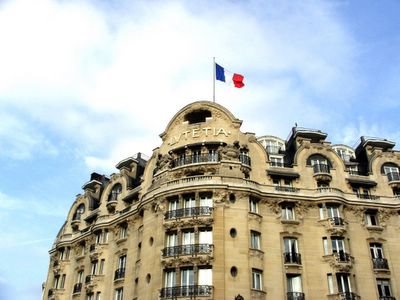
Exactly one week on, just as fans had jostled for position in the fish shop queue on the Uxbridge Road, sharp-elbowed Parisian ladies in cocktail dresses were making their presence felt at the Hotel Lutetia in the grander St Germain des Prés.

But who's to blame them? They'd sat or stood loyally through the 40th annual Prix Culinaire International Pierre Taittinger awards ceremony.

Those able to squeeze into the small hall where the announcements were made had warmly applauded Charly de Wijs, the Dutch winner of this year's prize. The rest nattered a little noisily in an adjoining room.

Trophies presented, it was now time for the serious business of the evening, a sumptuous buffet in the Salon Président of this palatial hotel on the corner of the Boulevard Raspail and Rue de Sèvres.

I always feel slightly uncomfortable in the Lutetia. It's the thought that within these walls people were tortured by German agents during the occupation of Paris.

Last night's feeding frenzy deepened that discomfort, though not quite enough to ruin the appetite.

Guests surrounded each serving table, two or three lines deep at the most popular ones, presenting a formidable obstacle to satisfying that appetite.

Fortified by a glass of bubbly, I persevered. It was worth the effort.

The president of the judging panel, Jacques Pourcel, celebrated co-owner with his twin brother of the Jardin des Sens in Montpellier, was lurking close to the first table entering the salon, and this seemed as good a recommendation as you could expect.

With his fellow judges, a well fed looking line-up, M Pourcel had spent part of the day in the kitchens of the Ecole Ferrandi for the deciding round of what Taittinger calls its gastronomic Nobel.

The seven finalists were each asked to prepare a whole turbot cooked with two sauces, one of which had to be Champagne-based. Francophone foodies should consult the fuller description* below.

In any event, Pourcel looked and sounded the kind of man who knew a thing or too about la bouffe, so I hovered close by. He was sampling the duck foie gras creation** of last year's winner, Jérôme Ryon, from the Carcassonne restaurant La Barbacane, and it turned out to be as delicious as anything else on offer around the room.

Before making my retreat - the place was probably too crowded with people I didn't know to enjoy for long - I had muscled my way through to the agneau d'Oc cooked with garlic, watched huge plates of oysters being rushed through by waiters to replenish depeleted stocks and grabbed a slice of Tomme de Savoie from a cheese display that also had Cantin, Beaufort, Chêne and Pigouille.

In a city packed with beggars, it is difficult not to feel a pang of guilt when taking part in such a feast, even if you do leave early. But then, they're unlikely to ask me back again next year.

* Each finalist was asked to prepare: Turbot presenté entier, farci de homard et nappé avec trois garnitures libres, 2 sauces (dont une sauce Champagne et un libre) et une tarte au citron meringuée.

** Full description of M Ryon's contribution to the buffet: Foie gras de canard cuit au naturel, "chouchou" et marmelade d'orange sur une brioche tiède.

Labels: , , , , , , ,