old salut!

Colin Randall wrote here on France, things Anglo-French and more......but has moved

April 16, 2007

Coming off fence, causing offence

Tomorrow is the day I have decided upon. None of the 12 French presidential candidates is shaking in his or her boots, no sleep is being lost and no votes depend upon it.

But I live in France, occupy my corner of an Anglo-French family and pay my taxes here. So I have a civic duty to declare my choice.

Watch this space tomorrow, if you are interested in knowing for whom my inactive votes are being cast this Sunday and at the playoff on May 6.

I had one of those useful opportunities at the weekend to view the issues from the other side of the Channel. The company I kept was intelligent and lively, and everyone knew there was actually an election in progress.

But the only people mentioned by name, without my prompting, were Nicolas Sarkozy and Jean-Marie Le Pen. Very well, someone may also have thrown a Ségolène or a Royal fleetingly into the conversation, but not with such interest or passion that I now remember the detail.

French politics rarely matter much back home, except during those intermittent crises - warfare in the past, agricultural policy now.

We are taught to regard the likes of Jacques Chirac as hate figures. The French, it is said and not only on www.****france.com, are driven by self-interest, arrogance and pride and by nothing else.

But even this is little more than a pantomime sideshow. For we are told by bonker English columnists that what this country really needs is a good walloping. And that only Sarko can administer it, with his pro reform, pro free market, pro Modèle Anglo-Saxon policies taking the role played by the martinets that once hung from hooks in French kitchens.

Those pundits probably do not know how little their views mean to him. But just as surely as Sarko has already watered down his promise to achieve "rupture" with the past and its failures, the truth is that he'll end up being very wary about doing very much at all that would suit the lovely-country-shame-about-the-people mob, the racaille of the English Right.

I did not mean to be so cruel on my confrères. If I use racaille, a contentious word that has brought Sarko much grief since he chose it to describe delinquents on suburban estates, I mean it in its broader sense of "rabble".

Most English language reporters prefer the harsher definition "scum" and may even be right (the only deciding factor, of course, being how the person on the receiving end interprets the word).

But how much interest is there generally in Britain in this political contest? Given that it's been a pretty drab campaign, I suspect that the answer reflects my exchanges when back home: Not Much.

Perhaps things will become more animated once 10 hopefuls have been cast out of the race, leaving us our top two playoff.

The tragedy is that the elimination of the also-rans is pretty certain also to entail the elimination of all the true characters of this campaign.

Labels: , , , , , , ,

April 11, 2007

New neighbours


Isn't it just a part of human nature to worry about the people who are about to move into your street?

Well OK, the Fort de Brégancon is a 10-minute drive away, not a few doors down the hill from us. And as you can see, it is not the kind of plcae where you just park outside and pop in for a cup of tea or glass of rosé.

But when the person who occupies it happens to be a head of state, you tend to play up the connection. Drinks on the patio here in Le Lavandou await the eventual winner, provided it's not Jean-Marie Le Pen. No guarantee, of course, that the invitation will be taken up.

Given the Fort's isolated location as the official holiday home for French presidents, les couples Sarkozy, Royal or Bayrou are not likely to drive all their neighbours wild with rowdy house-warmings or noisy, dusty building work. But we may yet bump into them if they venture into our neck of the local woods.

I know who I want to be there in the post-Chirac era. But if you want to know more about that, you will just have to keep coming back to Salut!, where I will declare my non-voting preference as we get nearer election day (April 22).

Labels: , , , , , ,

March 12, 2007

All right, Jacques?


Jacques Chirac was a neighbour in Paris. He remains an occasional one in the Var for the last weeks of his present job, since it has the perk of a holiday home down the road.

Though we choose not to live in each other's pockets, we have met twice - perhaps leaving the bigger impact on my memory - and I have observed him often enough to know I am not, at such times, in the presence of a monster.

My wife, in common with many French women, likes him. Her mother adored him and, I imagine, would have continued to do so had she not died before he became president.

But if you are British, and especially if you are English, Jacques Chirac is - or is meant to be - a hate figure.

This is expressed in more ways than the one chosen by a former editor of the Sun whose contribution to the entente cordiale was to dispatch a posse of Page 3 girls to the Champs Elysées, armed with a limited-issue edition of that day's paper, with Chirac depicted on the front as a worm.

Forget for a moment the inconvenient detail that, in Paris, to be likened to a worm will cause more bemusement than anything else (as my consoeur Agnès Poirier has pointed out in one of her books, Les Nouveaux Anglais, the term doesn't exist as an insult in French).

The gesture still reflected a view of the French president held pretty widely on the Sun's side of the Channel and the vulgar gimmickry of the tabloids has its equivalent in higher-minded journalistic circles.

Someone at that Other Place once inserted a word I had not used so that a piece written in the run-up to France's referendum on the EU constitution in 2005 declared that recent polls had confirmed the president's "worst fears that the electorate may use the referendum to register its disgust with him, his government and its lot in life".

I was cross at the time, not just because a colleague wishing to change copy in such a significant way should at least have the courtesy to mention his or her intentions in advance, but because the change introduced a word I considered far too harsh to describe the true nature of France's relationship with Chirac.

My own phrase had been "broader disapproval" and I might, on reflection, have chosen something stronger.

But disgust, while undoubtedly felt by an essentially partisan portion if the French electorate, was surely over the top and, in the specific case, much more accurately a reflection of what a middle-class Englishman of a certain political disposition believed.

Someone responding to one of my articles for the Guardian's Comment is Free web pages mocked Chirac's theory that it was more important to get on with governing France than satisfy media and political demands to end the guessing about his own future.


Picture: coombskj


A lot of French people I speak to would agree with that (French, I assume) person's criticism of his record in office, yet it is also commonplace to hear words of genuine admiration for the way he represents their country on the international stage.

But leave to one side his stand on Iraq and Chirac departs from the presidency having failed to make much impact on any of the important issues facing France. That puts into perpective all the attempts he has made during the dying months of his mandate to improve history's judgment on the Elysée years of his long career.

One former confidant, Franz-Olivier Giesbert, wrote in a scathing book last year that Chirac's career, which once promised a great deal, had ended up as "a personal tragedy that has become, in the end, a national tragedy".

This morning, more than one French commentator assessing last night's broadcast from the Elysée observed that here was a politician who was invariably stronger on analysis than on delivery, on words not actions.

Perhaps in the end, Chirac's failure was that no one was ever quite sure what he stood for, or whether what he stood for now was the same as what he stood for a little earlier.

He proved changeable on Europe and America, on the need to drive home reform in France; he opposed war in Iraq and loved to present himself as utterly committed to peace but was pig-headedly determined, as one of the first big decisions of his presidency, to try out his own nuclear weapons in the Pacific. He could be both a charmer, as I certainly found, and a bully (as Blair did).

If being detested by the American or English Right (or, for sure, the far Right of Le Pen) doesn't make him a bad person, Le Figaro could not help noting that he wasn't, at heart, a creature of the French Right either.

Much attention has been paid to his refusal to endorse Nicolas Sarkozy in the broadcast (he may, of course, do so later with whatever enthusiasm).

But I was left rather more intrigued by his reference to moving on from the presidency to serve France and the French in some other way. What can he possibly have in mind?

Labels: , , , , , , , , , , ,

February 20, 2007

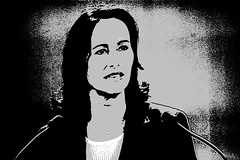
Ségo: it's tough being a woman

However you look at it, Ségolène Royal's television audience - a peak of just under 10.6 million viewers, an average of 8.9 million - proves she is a remarkable draw.
The average was comfortably higher than the ratings for her rival Nicolas Sarkozy's similar broadcast, itself described as a record for a political programme in France, two weeks ago.

Many people will have tuned in expecting, a lot of them hoping, to see Ségo stumble and fall. But she will take huge comfort from the figures, believing the massive penetration will help her rise above media, opposition and even Left Bank intellectual disdain.

Some will remember mention here of her steeliness and ambition being seen as faults, whereas in a man they'd be hailed as virtues.

This notion surfaced again the other day when she reacted sharply to questions about the abrupt resignation, allegedly over funding of her programme, of an economic adviser.

It was certainly an eyebrow-raising moment, and poor PR, but the writer of one column I saw couldn't resist adding that she was too quick to reveal herself as hard. Sarko seems to get off much more lightly when he makes ill-considered ripostes.

Last night, she argued that running for the presidency was harder for a woman, that no man would have had his competence questioned as constantly as has happened to her.

It was a long programme but I felt Royal did reasonably well after a ponderous start (not her fault; the first questioner was allowed to ramble for ever).

She made the right noises (for the left, so to speak) on youth unemployment, pensions, small businesses and the disabled. And she refused to be wrong-footed by questions about the Parti Socialiste "elephants", not least what role if any she would hand as President Royal to her partner François Hollande, the general secretary.

The moment when she walked over to console a wheelchair-bound man, in tears as he described living with MS, could have been embarrassing but wasn't. It looked a genuine gesture, but I suspect it will also have done her no harm.

I found her a little less assured on the presidency itself - "I think I am ready" hardly had the ring of confidence - and on that thorny issue of how she will pay for her programme. But Sarko has unanswered questions in that area, too.

François Bayrou, the centrist candidate who has been steadily improving his showing in the polls, is an interesting sideshow. I simply do not believe the poll that found he would beat either Ségo or Sarko if he made it through to the second round, but he is capable of inflicting damage, especially on her.

Royal's best bet, provided she can finally sort out her unimpressive campaign team, is that those 10.59 million viewers - isn't that 10,589,000 more than are canvassed in the average poll? - liked not only what they saw, which is usually the case, but what they heard, too.

Labels: , , , , , , , , , , ,

January 10, 2007

Elysée election: early result

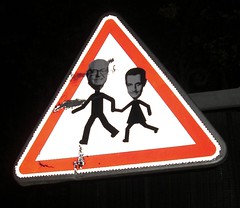
And the new president of France is Ségolène Royal.


Photograph by: PS Clichy sous Bois.


Don't just listen to me. Ségo's election in May, it seems, is the logical extension of claims by Jean-Marie Le Pen, leader of the far-Right Front National, that he will again make it through to the final round of the race - to face her in the deciding poll.

You would have to take a very dim view of the French to believe that given such a choice, more than a small minority of them would vote for Le Pen.

He naturally takes a different view. And there is some evidence that the opinion polls, which currently give his party only 15-17 per cent of popular support, consistently under-estimate his electoral pull.

But can Le Pen really hope to split the centre-Right vote to such an extent that Nicolas Sarkozy is eliminated in the first round as the socialist candidate Lionel Jospin was in 2002?

As a foreign observer of French politics who identified the presidential potential of Mme Royal some time before most, I am naturally pleased to see my instincts being vindicated.

She has a lead in the national polls, at least on first round voting intentions, and so far seems capable of making light of perceived weaknesses and gaffes.

With her radical - and, says the centre-Right, unworkable - ideas for helping the SDFs (France's great army of homeless people who have been turned into an early election issue), she has even begun to sound a little more Left wing.

This will satisfy some of the doubters in her own Parti Socialiste, who worried about her penchant for New Labour tactics with a French accent, appealing to middle France voters just as Tony Blair once offered olive branches to middle England.

And she has also managed to sound a little more Chiracien, with her echoes during her visit to China of his mantra that the world needs counterbalances to American superpower dominance. This, in turn, will please parts of la France profonde that still approve of the kind of France Jacques Chirac represents, if not of the man himself.

I loved that quote spotted by one of my readers, Richard of Orléans, to the effect that it was a big mistake to think of her as nice but unintelligent when she was in reality highly intelligent but not very nice.

But it won't harm her; in the end, I suspect a lot of French people sympathise with her riposte that what critics see as faults in her - her steeliness and ambition -would be considered virtues in a man.

If I am determined to rule out Le Pen's chances of bringing everlasting shame to France by reaching the Elysée, I am not wavering in my belief that M Sarkozy remains a massive obstacle to Mme Royal (and, of course, to M Le Pen's unappealing prediction).

Sarko will be formally installed as the UMP candidate this weekend and we will then see his campaign enter a much more urgent phase.

He is more than a match for Mme Royal in political debate, though his own female supporters have already urged him to avoid being seen as macho and sexist in his clashes with her.

When he talks about immigration and crime, and backs his words with firm action, he clearly impresses large numbers of voters and speaks their language.

Across the south of France from Marseilles to the Italian border, a new poll suggests, he is way ahead of both the socialists and Le Pen.

Questions have been asked this week about his dual role, candidate and minister (not forgetting that as well as being interior minister, the equivalent of the British Home Secretary, he is No 2 to Dominique de Villepin in government).

But he can be expected to stand down soon as France No 1 Cop - that's how the press likes to describe the interior minister - to concentrate on getting into the Elysée.

De Villepin has said he will not give his formal support to Sarko, but this is no surprise. Usually, of course, they don't even seem to belong to the same party, let alone work together in the top two Cabinet roles.

Since de Villepin notoriously is not even an elected politican, the absence of an endorsement from him will inflict little or no damage on the Sarko campaign. Nor will there be much fall-out from President Chirac's constant put-downs of his interior minister's more robust approach to solving France's problems.

But what of M Chirac's own immediate plans? Until quite recently, he was widely seen as an elderly man going through the motions of seeing out his final months of presidency, moreover a presidency judged by most to have been an abject failure.

In his New Year messages, however, he has taken to making what sound very much like declarations of intent for a further five-year mandate. His stance on the war in Iraq has increasingly been lauded as a rare success of his time as head of state.

Surely the very idea of him standing for a third term of office remains preposterous.

Maybe. But it has been treated by some commentators and political reporters in recent weeks as if well within the bounds of possibility.

The UMP, broadly, doesn't want him, nor does the public. But can we yet be sure? Le Figaro suggested the other day that he was talking up his programme of action for France's future as if he saw himself as the man to put it into effect.

M Chirac's wife, Bernadette, enjoyed causing a bit of mischief a month or two back by suggesting that her husband might yet put himself forward again.

And she did little to discourage the speculation when she stonewalled such questions while appearing on peak time television a couple of nights ago.

If, against all logic, he does stand, what banner will he choose? Since Sarko will be the official UMP choice, we could be looking at a One Nation One People contender offering, essentially, more of the same at just the time when France arguably needs something quite different.

Mme Chi-Chi can't or won't say. After insisting, implausibly, that such matters are simply not discussed between husband and wife, she added that Jacques would not even inform her of his decision until the eve of his eventual announcement.

What if he said he was going for it? Could such a step be sufficiently divisive of conservative voters to make the first part of M Le Pen's analysis come true?

Labels: , , , , , , , , , , , , ,

January 03, 2007

Paris: hits and misses, and a miss to miss

This blog is no longer the preserve of a Parisian, so perhaps it is too early to be too dogmatic about what to look back on with a smile and what to be glad to see the back of.

But here goes anyway:


Picture: JammyCat.


What I'll miss:

* The sheer man-made beauty of both banks of the Seine

* The Métro. Parisians complain, of course, but it almost always worked for me

* Eurostar within easy reach

* Being able to get Indian food delivered to the door (even the Parisian version is better than nothing)

* Rebecca. Who is Rebecca Schofield? Bill Taylor asked the question when I used Rebecca's computer to make an e-mail response to his photo website.
She is, or was, my assistant. As an Englishwoman living in Paris (with a rural bolt hole), and as wife, mother, go-getter and unrivalled collector of friends, she knows just about everything about living in France

* And Rebecca will miss being reminded of Robin, the young work experience visitor who wrote in his subsequent school project of her dynamism and her ability to keep her desk tidy "amidst general disorder". He also lopped 15 years off our ages

* That view. I tried my best to give the impression of being blasé, but you cannot keep a straight face for long while feigning indifference to a panorama that begins with the Louvre, takes in the Tuileries with the Musée d'Orsay, twin spires of Ste Clotilde and the Assemblée Nationale as backdrop before arriving at the Eiffel Tower via Invalides and the Champs Elysées. Breathtaking

* Keeping relatively fit by fast-walking circuits of the Tuileries

* Parisian jazz

* Lifts to Parisian badminton clubs from Ming Lam, my friend from the Auberge des Gourmets Chinese restaurant.

* Being able to walk to functions at the Elysée, Quai d'Orsay or British Embassy. In fact, being able to walk to most places in the city centre

* Easy access to live English football whether or not you secretly have one of those Sky cards at home

And what I won't:

* The price of everything from mushroom omelette and chips to an unremarkable baguette in the 1st arrondissement

* The army of beggars. Paris seems to have more than most cities and a large proportion seems genuine, distinguishing them from the shift working professionals I have seen in action from Lyons to London. If the current wave of protests in support of France's SDFs - sans domicile fixe - inspires effective, humane action, it has my blessing

* Having to count a few extra seconds as drivers whizz by after pedestrian crossing lights turn green, and even then venturing out warily

* The feeling at the height of summer that there is no escape from the clammy heat

* Clanking old lifts that spot heavy bags a kilometre off and render themselves en panne

* And yes, there has to be more. But for once, I have run out of negative thoughts.....for now.

Labels: , , , , , , , , , , , , , , , , ,

December 28, 2006

Gone today, Hyères tomorrow


Salut! is on the move.

Surrounded by cartons stuffed with millions of folk CDs, football fanzines and books on everything from the French revolution to the history of badminton, we bid farewell to Paris.

Specifically, it is adieu to the rue de Rivoli, our grand if not very homely home for the past two-and-a-half years. Part of the magnificent view from the living room is captured inexpertly here (where's Bill when you need him?).

Tomorrow, we will pass the busy little Mediterranean town of Hyères - which really has nothing much to do with this except that I couldn't resist the title - on the final approach to Le Lavandou and a new life there.

There is little time between filling in insurance forms and supervising the removal of our belongings to say much more, and there is also little need.

But what will I tell my neighbour Jacques Chirac? Despite our ups and downs, the president has gamely invited me back to the Elysée for the New Year's drinks reception he throws for journalists each January.

This, we can safely assume, will be his last such voeux, and it looks as if I shall be among absentees.

And the loss of presidential office will mean that the Chiracs will also no longer be our neighbours in the Var, since their holiday home at, the Fort de Brégançon, goes with the job. But somehow I feel our paths will cross again.

I'll be back here soon enough once we've settled in, with reflections on what I will and will not miss about Paris. In the meantime, I will lift France in Flashes near the top of the blog in case the more recent additions inspire further comment.

Labels: , , , , , , , , , ,

December 13, 2006

Marine Le Pen and the pink culottes


The National Front is a Nazi front. So the counter-demonstrators always chanted when I was reporting on its marches, and I am quite sure they held similar sentiments about Jean-Marie Le Pen’s French equivalent, the Front National.

But is Le Pen’s daughter Marine trying to force the party to change Nazi front to Nicer front?

Among a set of new posters she launched for the party’s 2007 presidential election campaign was one showing a young woman of obvious Arab origin in Le Pen supporting mode.

Ils ont tout cassé,” the girl says, thumb down as she echoes the FN’s contemptuous judgment on the mainstream French Left and Right: roughly speaking, they’ve failed you, the French, on all the issues that matter.

She does not leave it there. The pose finds her alongside four keynote symbols of your nicer Front National – nationality, integration, social mobility, secularism.

And, horror of horrors, she is wearing not a modest headscarf and sensible all-over clothing but low-slung jeans, showing bare midriff and – clearly enough to give the FN’s old codgers heart failure - the top of her pink knickers, or culotte rose as the French press helpfully puts it.

The girl’s deeper thoughts on immigration are so far unrecorded, at least to my knowledge. Le Pen himself certainly hasn't changed; he was getting agitated again on the subject only the other day, accusing the French government of lying about the true scale of immigration from the Third World.

But then I am currently in London and the French press may for once have set about doing what the British papers would already have done in similar circumstances and unearthed our lepéniste maghrébine.

Le Figaro's coy account of the affair quotes a prominent FN official with a name splendidly evocative of both militarism and Germany, Martial Bild, as acknowledging that the mode of dress may be “too much” - uttered in English for effect – for some.

But Marine Le Pen, the FN's vice-president and strategic director of its Elysée campaign, insisted that no one was challenging the principles behind the poster campaign. The only reservations, she said, concerned the visible thong.

“Some French people of immigrant origin are aware of the failure (of Left and Right) and a lot of those are turning to Jean-Marie Le Pen for answers,” she added.

Even old lags, I suppose, should be allowed a chance of rehabilitation.

But while Martine Le Pen and Martial Bild congratulate their party for moving forward in a positive way and doing what would have been unthinkable only a few years ago, I have one nagging spoilsport thought.

If the Front National is no longer to be an odious party of racism and other base human instincts, what is it for at all?

Labels: , , , , , , , , , , ,

November 30, 2006

The way to treat a lady


Even as Nicolas Sarkozy formally announces what everyone has known for years - that he intends to stand for the French presidency - an eye-catching trip by Ségolène Royal to the Middle East threatens to steal his thunder.

Sarko undeniably represents a formidable obstacle to Mme Royal's hopes of becoming the first female president.

But just how formidable is becoming increasingly tricky to gauge as the Ségo phenomenon continues to achieve the improbable - making French politics interesting outside France in what is still a non-election year.

International attention packs little electoral muscle, of course. Yet even that works both ways; a lot of the overseas support for Sarko tends to come from the sort of conservatives from whom millions of French voters would run a kilometre or two.

At home, Sarko plainly has work to do, and an illuminating vox pop in Le Figaro offers a little advice on how he should treat a lady when that lady stands between him and the Elysée.

The paper canvassed the views of several prominent females from the party and the responses revealed hints of anxiety that M Sarkozy's tendency to shoot first and reflect later may cost him votes.

"Nicolas must take care not to be aggressive, but to tackle her ideas and not the person," warned Isabelle Debré, a UMP senator. "The slightest gesture could be raise charges of misogyny."

Arlette Franco, from the western Pyrénées, wanted to see more of a side to Sarko that we generally encounter only when he is having one of his marital reconciliations.

"He needs to offer reassurance, to show himself to be warm, human and interested in social questions as well as security," she said.

Another Arlette - Grosskost, from Haut-Rhin - suggested that Sarko should surround himself with more women, lighten his hard-line image and acknowledge that Mme Royal's appeal by-passed political logic.

And a Parisian MP, Martine Aurillac, went so far as to offer the sort of counsel even France's macho hommes politiques would consider patronising: "Don't launch into discussions that are too technical, statistical, complicated."

Her theme was taken up by Valérie Pécresse, spokesman for the centre-Right UMP party of which Sarko is president. Confronting a female opponent, she said, was to be engaged not in a classic clash of forces but in a clash of conviction.

"You have to address the people in very simple terms," she said, while adding loyally that Sarko understood this parfaitement.

The subtext of all this is clear enough. Sarko may be capable
of tearing Ségo apart in contentious debate, but should weigh up whether it would actually do him much good?

We know Mme Royal has so far shown little substance to go with the lashings of style, a point of view that surfaced in France long before it became a British media cliché.

It has done her little damage in the polls. One of my own human barometers of middle France opinion, a middle-aged, mid-management bank employee (and typical UMP voter) living in the provinces, summed it up quite neatly.

"You say we don't know what she stands for, that she is woolly on the main issues," he said. "I think that's part of what the French like about her. There's less to be scared of."

Sarko profits this week from a flurry of attention surrounding his announcement. But unless Ségo commits some appalling gaffe in Lebanon, Israel or the Palestinian territories, she stands a good chance of bagging at least equal airtime and headlines for the right reasons.

Adding a thought after the event, it is even possible to say that when the gaffe came - failing to slap down a Hizbollah attempt to equate Israel with the Nazis - she and her supporters performed some smart wriggling.

We should all stand by, I'd guess, for a little more evidence of Ségo steel in the coming weeks and months, and for the odd sign of a mellower Sarko.

He may have taken heed of those female colleagues already. The famous promise of "rupture" - implying a complete break with failed policies of France's recent past, however this might enrage surly unions and those desperate to cling to outdated privilege - has already been watered down.

Now, he says, it will be a "peaceful rupture".

Labels: , , , , , , , ,