old salut!

Colin Randall wrote here on France, things Anglo-French and more......but has moved

March 15, 2007

Polls built from straw?

parisdailyphoto

Each time the temptation arises to be sniffy about opinion polls, I take care to remind myself that in a past life, I had regular dealings with pollsters.

Once a month, Anthony King, gentleman, scholar and highly entertaining company, would call at the Telegraph offices in Canary Wharf with a couple of executives from YouGov to discuss future polls.

Guests and assorted hacks alike would be offered champagne on arrival for lunch, and good wine was then served in reasonable though hardly excessive quantities throughout the convivial meal that invariably followed. Ideas would be tossed around until some firm plan evolved.

In an austere new world, a stop was soon put to the champagne and wine, of course, though I am glad to say that Britain and I had parted company by then.

The conviviality, I am sure, survived the prissy change and the lunches will doubtless have remained as businesslike and productive as before, though I am prepared to bet they are not more so.

Professor King - or better, Tony - takes a highly methodical approach to his preparation of polls, and the analysis of their findings.

Viewers will know all about that if they have tuned in on election night and seen him assessing the exit polls and early declarations from places like Sunderland South (honest - they're always first or nearly first) and Billericay.

With his photographic memory and grasp of detail, Tony is a sort of Canadian Leslie Welch of politics and psephology.

He was a great fan of YouGov, which conducts its surveys via the internet.

I was always a little less convinced by this method of monitoring public opinion; the cyber age was not at that point so firmly established as it is now and whole swathes of voters were necessarily excluded.

When I suggested a poll of British Muslim attitudes on such issues as citizenship, loyalty and terrorism in the aftermath to Sept 11 and military action in Afghanistan, the problems of creating a viable sample very nearly proved fatal to the exercise.

In the event, the YouGov findings - though based on a sample as low as it could get before the level at which Tony would have advised against going ahead - mirrored those of subsequent polls on the same subject carried out by more conventional means and with many more respondents.

Pollsters know the science of their métier, and will usually argue that it gives a very reasonable prospect of an accurate reflection of public opinion.

But in the case of my Muslim poll, I felt very strongly at the time that the most valuable part of the project was the work of two reporters of Asian background who were sent off to canvass views in towns with large Muslim populations.

One of them turned in a weighty tome running to thousands of words which I had to whittle down to a few hundred. Useful as his research was in shaping our coverage, I remember hoping that he would find a home for an uncut version of his extraordinarily detailed epic.

My doubts about polls do not end with the internet since there are other ways in which the process of choosing a sample is flawed, a view reinforced by a small article seen in Le Canard Enchainé on the train from Toulon to Paris (a visit that may explain my silence here since Monday).

If the old Chained Duck is to be believed, and often it can, French polling institutions routinely exclude 31 per cent of the French from their telephone surveys, for the simple reason that those taking part are selected from listed, fixed-line subscribers.

Yet there is an army of people out there that has no phones of any kind, makes all or virtually all its calls on mobiles or uses internet phone services such as Skype. Young voters and people on modest incomes are said to be particularly likely to fall into one of these categories.

Add to that the obvious fact that not everyone likes being bothered by cold callers - and as many as 30 per cent refuse to take part - and you begin to see the fault lines developing.

The margin of error surely gets wider if you take account of such drawbacks, and there are at least three other complications affecting the French presidential elections:
* large numbers of apparently undecided voters
* the emergence of a strong third contender (Le Pen in 2002, Bayrou this time)
* the exclusion of French citizens - 2.3 million of them - living in the Dom-Toms, overseas departments and territories.

Does it matter? Well, yes it does. I see weight to the argument that polls have an ability to shape - in other words distort - the public view, or to encourage tactical voting that might not otherwise have occurred.

It is just as well, as I said in a piece at the Guardian Comment Is Free site, that France bans opinion polls in the last week of campaigning.

But, repeating from that item what I take to be the logical follow-up question, would it not make the democratic process a shade more democratic if we were to impose a much longer ban?

We are within six weeks of the first round of the presidential elections, and François Bayrou's success as Third Way candidate is inspiring all sorts of mathematical as well as political calculation.

How much healthier it would seem if we knew there wouldn't be another poll from a week on Saturday until the real votes were cast on April 22.

Labels: , , , , , , ,

February 20, 2007

Ségo: it's tough being a woman

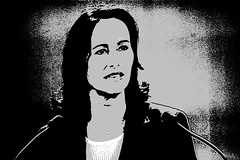
However you look at it, Ségolène Royal's television audience - a peak of just under 10.6 million viewers, an average of 8.9 million - proves she is a remarkable draw.
The average was comfortably higher than the ratings for her rival Nicolas Sarkozy's similar broadcast, itself described as a record for a political programme in France, two weeks ago.

Many people will have tuned in expecting, a lot of them hoping, to see Ségo stumble and fall. But she will take huge comfort from the figures, believing the massive penetration will help her rise above media, opposition and even Left Bank intellectual disdain.

Some will remember mention here of her steeliness and ambition being seen as faults, whereas in a man they'd be hailed as virtues.

This notion surfaced again the other day when she reacted sharply to questions about the abrupt resignation, allegedly over funding of her programme, of an economic adviser.

It was certainly an eyebrow-raising moment, and poor PR, but the writer of one column I saw couldn't resist adding that she was too quick to reveal herself as hard. Sarko seems to get off much more lightly when he makes ill-considered ripostes.

Last night, she argued that running for the presidency was harder for a woman, that no man would have had his competence questioned as constantly as has happened to her.

It was a long programme but I felt Royal did reasonably well after a ponderous start (not her fault; the first questioner was allowed to ramble for ever).

She made the right noises (for the left, so to speak) on youth unemployment, pensions, small businesses and the disabled. And she refused to be wrong-footed by questions about the Parti Socialiste "elephants", not least what role if any she would hand as President Royal to her partner François Hollande, the general secretary.

The moment when she walked over to console a wheelchair-bound man, in tears as he described living with MS, could have been embarrassing but wasn't. It looked a genuine gesture, but I suspect it will also have done her no harm.

I found her a little less assured on the presidency itself - "I think I am ready" hardly had the ring of confidence - and on that thorny issue of how she will pay for her programme. But Sarko has unanswered questions in that area, too.

François Bayrou, the centrist candidate who has been steadily improving his showing in the polls, is an interesting sideshow. I simply do not believe the poll that found he would beat either Ségo or Sarko if he made it through to the second round, but he is capable of inflicting damage, especially on her.

Royal's best bet, provided she can finally sort out her unimpressive campaign team, is that those 10.59 million viewers - isn't that 10,589,000 more than are canvassed in the average poll? - liked not only what they saw, which is usually the case, but what they heard, too.

Labels: , , , , , , , , , , ,

January 02, 2007

Zizou: the ifs and butts

It does not take much insight into the English way of seeing and doing things to imagine the repercussions had one of our World Cup squad ended his career in Zinedine Zidane fashion.


An English Zidane would have been torn to pieces by press and public, hounded from pillar to post and left feeling he alone had cost his country victory.

In time, he would have been able to shrug off Most Hated Public Figure status. But he would never have been allowed completely to forget the moment of shaming stupidity.

And he most certainly would not, less than six months after the event, have been named his country's most popular personality in a respectable opinion poll.

But that is what has happened in France. Zidane's act of violence, butting the oafish Italian Marco Materazzi under some verbal provocation, has not so much been forgotten as ignored or understood or even applauded by the French public.

Zidane was one of my two favourite footballers of his time, another Frenchman - Thierry Henry - being the other. But my admiration for his consummate skill did not lead me to overlook his appalling disciplinary record - 13 red cards, more than a few of them for behaving as a lout.

On the morning after the last dismissal of Zidane's career contributed greatly to the wrong team winning the 2006 World Cup, the French sports daily L'Equipe gave front page prominence to a stern, headmasterly piece asking how he would explain his coup de tête to millions of youngsters who looked to him as a role model.

That is about as long as Zizou's humiliation lasted.

Later the same day, President Chirac cleverly sensed and exploited what was quickly becoming the public mood, and welcomed the French squad back to Paris as returning heroes and making light of Zidane's disgrace.

Before long, a jolly pop record glorifying the assault on Materazzi was all over the radio and in the charts.

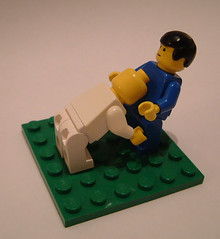
An interview in which Zidane explained himself - a bit, and with regret but not apology - was to become the most-viewed Canal+ programme of the year. And someone in Italy began marketing sweatshirts showing two figures simulating the incident.

So which approach is right? I tend to agree with those who feel the British are far too quick to build 'em up and bring 'em down.

David Beckham did not deserve the abuse he received for the petulance that brought him a red card in France 98. Football is a game of passion and a player should not be consigned to eternal shame for a sudden loss of control.

But nor does Zizou deserve to be hailed the people's hero so soon after setting such an appalling example.

The French who voted for him acted like those parents from hell whose idea of supporting little Darren and Jason in a school match is to jump up and down on the touchline urging children to replicate the excesses of millionaire superstars they see on the telly.

Labels: , , , , , , , , , , ,