old salut!

Colin Randall wrote here on France, things Anglo-French and more......but has moved

February 20, 2007

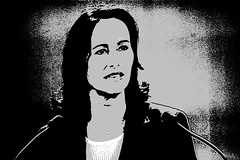
Ségo: it's tough being a woman

However you look at it, Ségolène Royal's television audience - a peak of just under 10.6 million viewers, an average of 8.9 million - proves she is a remarkable draw.
The average was comfortably higher than the ratings for her rival Nicolas Sarkozy's similar broadcast, itself described as a record for a political programme in France, two weeks ago.

Many people will have tuned in expecting, a lot of them hoping, to see Ségo stumble and fall. But she will take huge comfort from the figures, believing the massive penetration will help her rise above media, opposition and even Left Bank intellectual disdain.

Some will remember mention here of her steeliness and ambition being seen as faults, whereas in a man they'd be hailed as virtues.

This notion surfaced again the other day when she reacted sharply to questions about the abrupt resignation, allegedly over funding of her programme, of an economic adviser.

It was certainly an eyebrow-raising moment, and poor PR, but the writer of one column I saw couldn't resist adding that she was too quick to reveal herself as hard. Sarko seems to get off much more lightly when he makes ill-considered ripostes.

Last night, she argued that running for the presidency was harder for a woman, that no man would have had his competence questioned as constantly as has happened to her.

It was a long programme but I felt Royal did reasonably well after a ponderous start (not her fault; the first questioner was allowed to ramble for ever).

She made the right noises (for the left, so to speak) on youth unemployment, pensions, small businesses and the disabled. And she refused to be wrong-footed by questions about the Parti Socialiste "elephants", not least what role if any she would hand as President Royal to her partner François Hollande, the general secretary.

The moment when she walked over to console a wheelchair-bound man, in tears as he described living with MS, could have been embarrassing but wasn't. It looked a genuine gesture, but I suspect it will also have done her no harm.

I found her a little less assured on the presidency itself - "I think I am ready" hardly had the ring of confidence - and on that thorny issue of how she will pay for her programme. But Sarko has unanswered questions in that area, too.

François Bayrou, the centrist candidate who has been steadily improving his showing in the polls, is an interesting sideshow. I simply do not believe the poll that found he would beat either Ségo or Sarko if he made it through to the second round, but he is capable of inflicting damage, especially on her.

Royal's best bet, provided she can finally sort out her unimpressive campaign team, is that those 10.59 million viewers - isn't that 10,589,000 more than are canvassed in the average poll? - liked not only what they saw, which is usually the case, but what they heard, too.

Labels: , , , , , , , , , , ,

February 16, 2007

Pottering about in the Guardian

First a few words of reassurance. My appearances elsewhere in cyberspace do not mean that Salut!'s days are numbered, or not yet at any rate. Especially since I now see that my advertising earnings have crept up to an average of 17 cents a day.


Picture: Si1very


But regulars around these parts may be interested to learn that I have found one or two other journalistic outlets to satisfy myself that, all that "garden leave" now over, there is indeed life beyond the Telegraph.

The First Post, a newsy site which already appears to be a home for other former colleagues, has already run a few articles.

There have been two or three on the presidential elections, naturally, but also one apiece on the French smoking ban and a couple of villas that Saddam Hussein's regime bought in the south of France with money that, arguably, could have been better spent in Iraq.

As of tonight, I am also a contributor to CommentIsFree, a talkative and animated corner of the Guardian's website. Ségolène's continuing struggles preoccupied me today, but my hope is to broaden the range of topics much as I try to do here. That link now seems to work.

At my leaving party - sorry, one of my leaving parties, this one in the Cheshire Cheese pub off Fleet Street - I began by condemning my former employers for their cruel and vindictive decision to give me more time to spend with Sunderland football club.

Those with my best interests at heart will be relieved to hear that I have found something more thoughtful than Salut!'s football offshoot to help occupy my time.

Labels: , , , , , , , , ,

January 22, 2007

Abbé Pierre: uncommonly great, uncommonly honest


You had your Queen Mother, we had Abbé Pierre.
A remarkable priest and what he meant to France were summed up in those nine words. They came in response to my expression of mild surprise
that France 2 had devoted almost the whole of its lunchtime news to his death, aged 94.


Photograph: Abbé Pierre Foundation


There was a significant difference between the Queen Mother and Abbé Pierre. Whereas she was known universally, his was hardly a household name outside France.

At home, though, this friend to the poor, indefatigable battler for the under-privileged was a true saint in the minds of people who shared his concerns and liked his rebellious spirit, but could not hope to match his commitment.

That is why we were treated to reams of old footage with snapshot glimpses of a great man's life, reverential tributes from a succession of studio guests and clips of today's words of praise from everyone who matters or hopes to matter in France.

Chirac, of course; he is actually very impressive in such circumstances, and spoke of France losing "an immense figure, a conscience, and incarnation of good". Then Ségo, Sarko and the lesser presidential candidates.

As someone from France 2 put it, Abbé Pierre's appeal transcended real and supposed barriers; he was adored and admired by young and old, men and women, rich and poor, Left and Right.

In today's small hours, he knew he was dying, beaten by bronchitis, but had no fear of death, we discovered from one of the speakers. A niece, and an executive of the worldwide Emmaus charity network that he created, sat with him and prayed until he breathed his last at 5.25am.

By midday, they were talking of burying him among the greats at the Panthéon, of giving his name to the law on rights for the homeless about to go before the French parliament.

In fact, he had already expressed a clear desire to be laid to rest among colleagues from his 1954 campaign for the poor and unsheltered, during a ferociously cold winter. That will take his bones to Esteville in Normandy, where he lived for most of the 1990s at an Emmaus retirement home.

As for laws in his name, I doubt if he could have cared less. His foundation was not prepared to go beyond giving the legislation a oui mais, seeing it only as a useful start.

But the thing that struck me most about Abbé Pierre during the last two years of his life was that he remained one of his country's most popular citizens even though - perhaps because - he was big enough to own up to human weakness.

Towards the end of 2005, he admitted in a book that he had more than once broken his vow of chastity as a Roman Catholic priest.

Looking at the old television and newsreel film of a good-looking young man - if priests can be swashbuckling, he was - it was not hard to see that temptation would have crossed his path.

There had, he said, been "passing relations" with women, though he had not felt able to commit himself to anything more lasting: "I was very young when I dedicated my life to God and other people.

"I made my vow of chastity, but that did nothing to remove the strength of desire, to which I have succumbed in passing fashion......I could not allow sexual desire to take root. I therefore have known such desire, and on rare occasions satisfied it, but in reality this satisfaction has been a real source of dissatisfaction because I felt I was not being true.

"To be properly satisfying, sexual desire had to express itself in a loving, tender and trusting relationship. That was not open to me because of my chosen life."

I do not know how this went down in the Vatican.

But to their credit, it seems to have mattered not a jot to the French. Only a few months after making these comments, he was voted the third greatest Frenchman of all time, behind only de Gaulle and Pasteur.

Labels: , , , , , , , , , , , ,

January 15, 2007

The socialist guru among Sarko's new best friends

French socialists were choking on their coffee and croissants this morning as they took in the small print of Nicolas Sarkozy's speech at the Porte de Versailles shindig launching him as the centre-Right presidential candidate.


Image: lfone.


If the trouble with French streets is that too many of them are named after Jean Jaurès, as a character remarked in the 1970s Gérard Depardieu film Maitresse, the trouble with Jaurès is that his admirers now apparently include Sarko.

François Hollande, general secretary of the Parti Socialiste and the father of Ségolène Royal's children, thinks the old lefty must be rattling round in the grave to which an assassin consigned him on the eve of France's entry into the First World War.

Hollande did not need to complete his own indignant riposte: "Pauvres Jaurès! If only he had known that one day his name would be cited at a conference of the French Right......."

I dread to think what some of those Right-wing tubthumpers who champion Sarko so enthusiatically would make of his soft spot for Jaurès.

This, after all, was the man who helped create the party of Hollande and Ségo, founded what became France's Communist paper L'Humanité and opposed the Great War (it was his pacifistic objections to the conflict that got him killed).

But let us not forget Margaret Thatcher on the steps of 10 Downing Street, marking her arrival as Prime Minister by adopting the words of St Francis of Assisi.

"Where there is discord, may we bring harmony," she declared. "Where there is error, may we bring truth. Where there is doubt, may we bring faith. And where there is despair, may we bring hope."

Others were to assess quite harshly how much harmony, truth, faith and hope Maggie and her ministers brought, for example, to east Durham and South Wales.

Hollande may regard Sarko as having misappropriated the heritage of a French socialist hero. The Left-of-centre Libération took a slightly kinder view.

"Can a man who invokes Jaurès, Hugo, Mandel and Zola be wholly bad?" the paper asked. "Can a man who wants an irreproachable democracy be accused of rampant Le Pen-ism? Is a man who talks at length about the rights of the badly housed and the welfare of others be described as ultra-liberal?"

While conceding that there was much of the "well-known Sarkozy cynicism" in all this, the Libé editorialist was gracious enough to conclude that for all that could be said to Sarko's detriment, he had produced an impressive performance.

Over to you Ségo.

Labels: , , , , , , , , , , , ,

January 10, 2007

Elysée election: early result

And the new president of France is Ségolène Royal.


Photograph by: PS Clichy sous Bois.


Don't just listen to me. Ségo's election in May, it seems, is the logical extension of claims by Jean-Marie Le Pen, leader of the far-Right Front National, that he will again make it through to the final round of the race - to face her in the deciding poll.

You would have to take a very dim view of the French to believe that given such a choice, more than a small minority of them would vote for Le Pen.

He naturally takes a different view. And there is some evidence that the opinion polls, which currently give his party only 15-17 per cent of popular support, consistently under-estimate his electoral pull.

But can Le Pen really hope to split the centre-Right vote to such an extent that Nicolas Sarkozy is eliminated in the first round as the socialist candidate Lionel Jospin was in 2002?

As a foreign observer of French politics who identified the presidential potential of Mme Royal some time before most, I am naturally pleased to see my instincts being vindicated.

She has a lead in the national polls, at least on first round voting intentions, and so far seems capable of making light of perceived weaknesses and gaffes.

With her radical - and, says the centre-Right, unworkable - ideas for helping the SDFs (France's great army of homeless people who have been turned into an early election issue), she has even begun to sound a little more Left wing.

This will satisfy some of the doubters in her own Parti Socialiste, who worried about her penchant for New Labour tactics with a French accent, appealing to middle France voters just as Tony Blair once offered olive branches to middle England.

And she has also managed to sound a little more Chiracien, with her echoes during her visit to China of his mantra that the world needs counterbalances to American superpower dominance. This, in turn, will please parts of la France profonde that still approve of the kind of France Jacques Chirac represents, if not of the man himself.

I loved that quote spotted by one of my readers, Richard of Orléans, to the effect that it was a big mistake to think of her as nice but unintelligent when she was in reality highly intelligent but not very nice.

But it won't harm her; in the end, I suspect a lot of French people sympathise with her riposte that what critics see as faults in her - her steeliness and ambition -would be considered virtues in a man.

If I am determined to rule out Le Pen's chances of bringing everlasting shame to France by reaching the Elysée, I am not wavering in my belief that M Sarkozy remains a massive obstacle to Mme Royal (and, of course, to M Le Pen's unappealing prediction).

Sarko will be formally installed as the UMP candidate this weekend and we will then see his campaign enter a much more urgent phase.

He is more than a match for Mme Royal in political debate, though his own female supporters have already urged him to avoid being seen as macho and sexist in his clashes with her.

When he talks about immigration and crime, and backs his words with firm action, he clearly impresses large numbers of voters and speaks their language.

Across the south of France from Marseilles to the Italian border, a new poll suggests, he is way ahead of both the socialists and Le Pen.

Questions have been asked this week about his dual role, candidate and minister (not forgetting that as well as being interior minister, the equivalent of the British Home Secretary, he is No 2 to Dominique de Villepin in government).

But he can be expected to stand down soon as France No 1 Cop - that's how the press likes to describe the interior minister - to concentrate on getting into the Elysée.

De Villepin has said he will not give his formal support to Sarko, but this is no surprise. Usually, of course, they don't even seem to belong to the same party, let alone work together in the top two Cabinet roles.

Since de Villepin notoriously is not even an elected politican, the absence of an endorsement from him will inflict little or no damage on the Sarko campaign. Nor will there be much fall-out from President Chirac's constant put-downs of his interior minister's more robust approach to solving France's problems.

But what of M Chirac's own immediate plans? Until quite recently, he was widely seen as an elderly man going through the motions of seeing out his final months of presidency, moreover a presidency judged by most to have been an abject failure.

In his New Year messages, however, he has taken to making what sound very much like declarations of intent for a further five-year mandate. His stance on the war in Iraq has increasingly been lauded as a rare success of his time as head of state.

Surely the very idea of him standing for a third term of office remains preposterous.

Maybe. But it has been treated by some commentators and political reporters in recent weeks as if well within the bounds of possibility.

The UMP, broadly, doesn't want him, nor does the public. But can we yet be sure? Le Figaro suggested the other day that he was talking up his programme of action for France's future as if he saw himself as the man to put it into effect.

M Chirac's wife, Bernadette, enjoyed causing a bit of mischief a month or two back by suggesting that her husband might yet put himself forward again.

And she did little to discourage the speculation when she stonewalled such questions while appearing on peak time television a couple of nights ago.

If, against all logic, he does stand, what banner will he choose? Since Sarko will be the official UMP choice, we could be looking at a One Nation One People contender offering, essentially, more of the same at just the time when France arguably needs something quite different.

Mme Chi-Chi can't or won't say. After insisting, implausibly, that such matters are simply not discussed between husband and wife, she added that Jacques would not even inform her of his decision until the eve of his eventual announcement.

What if he said he was going for it? Could such a step be sufficiently divisive of conservative voters to make the first part of M Le Pen's analysis come true?

Labels: , , , , , , , , , , , , ,