Pride, prejudice and the press
Reading about the life and times of Maurice Papon, the Vichy collaborator who signed French Jews' death warrants, I felt the glow of distantly reflected pride.
Here, and over at Roy Greenslade's Guardian blog, there has lately been talk of how ritualistic prejudice againt the press leads to grotesque libel awards that (should) bring shame to the countries and courts in which they are made.
Not everyone agrees with me or the similar, though hardly identical, views expressed by my fellow blogger.
But turning to Papon, let us start with the proposition that his exposure as a war criminal was no bad thing.
That will not seem too controversial a point to most of those who stray into Salut!.
But how did that exposure come about, given that Papon proceeded from being the second most senior French official in wartime Bordeaux to a very prominent post-war career in public life (though that career was scarcely without disgrace)?
It came about because the press (newspapers) did what it is - they are - best at.
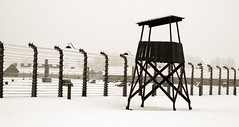
In May 1981, France's satirical weekly, Le Canard Enchainé, revealed documents establishing Papon's culpability in the deportation of nearly 1,700 Jews from Bordeaux to the Drancy internment camp on the outskirts of Paris between 1942 and 1944.
Many of these unfortunates went from Drancy to Auschwitz. Very, very few came home. As the Allied victory neared, Papon saw what was coming and switched sides, reinventing himself as a Resistance informer and later collecting an honour from General de Gaulle for his pains.
Ultimately, he was jailed for 10 years for crimes against humanity. He fled to Switzerland but was returned to serve all of three years of his sentence.
As a self-confessed liberal on penal issues, I have no real complaint about his release in 2002 on health grounds. But Papon goes to his grave having never found the courage or humility to admit to his wrongdoing.
He insisted to the end that he was the blameless victim, as (with variations to the theme) is so often the case among those who dislike how they portrayed in newspapers, of "unprecedented media pillorying made up of lies, insults and infamy".
Great stuff, Le Canard Enchainé! I have said the French press is more decent but also more dull than the British variety, but here it managed to be both immensely decent and a long way from dull.
And so it is on the other side of the Channel. The press, from ruthless proprietors to individual journalists, makes plenty of mistakes. Sometimes the mistakes are serious and, much more rarely, they have serious consequences.
But often, the press is punished disproportionately for its mistakes; the rich, powerful and merely fortunate would be horrified at how low I'd cap libel awards, while insisting on due - OK, French-style - prominence for apologies or corrections.
And almost always, the press attracts far less praise than it deserves when it acts in its own loftier traditions.
Leave aside the unmasking of war criminals or the spotlights trained on government and corporate injustices.
For every unfairly criticised politician, pop star and supermodel, there are scores of ordinary people who have been assisted, by local and national newspapers alike, towards some semblance of fair treatment in their David vs Goliath battles with gas boards, insurance companies, banks and other private or public bodies.
Unfashionable, especially on a blog, and probably unnecessary since I no longer have a newspaper job, but true.
Labels: Auschwitz, Drancy, Jews, Le Canard Enchaine, newspapers, Papon, press
By Colin Randall @ Monday, February 19, 2007 ¦
17 comments